For over a decade, the marketing engine behind cloud computing has successfully abstracted the concept of physical infrastructure. We are told that data lives "in the cloud," an ethereal, borderless digital space where geographic location is irrelevant.
From a legal and compliance perspective, this is a dangerous illusion.
The internet may feel borderless, but the physical hard drives that store your data reside within the sovereign borders of nation-states. Consequently, that data is governed by the laws, surveillance mandates, and privacy regulations of those specific countries. For enterprises operating within or serving the European Union, the physical location of your infrastructure is not merely a technical consideration—it is the foundational pillar of your legal compliance strategy.
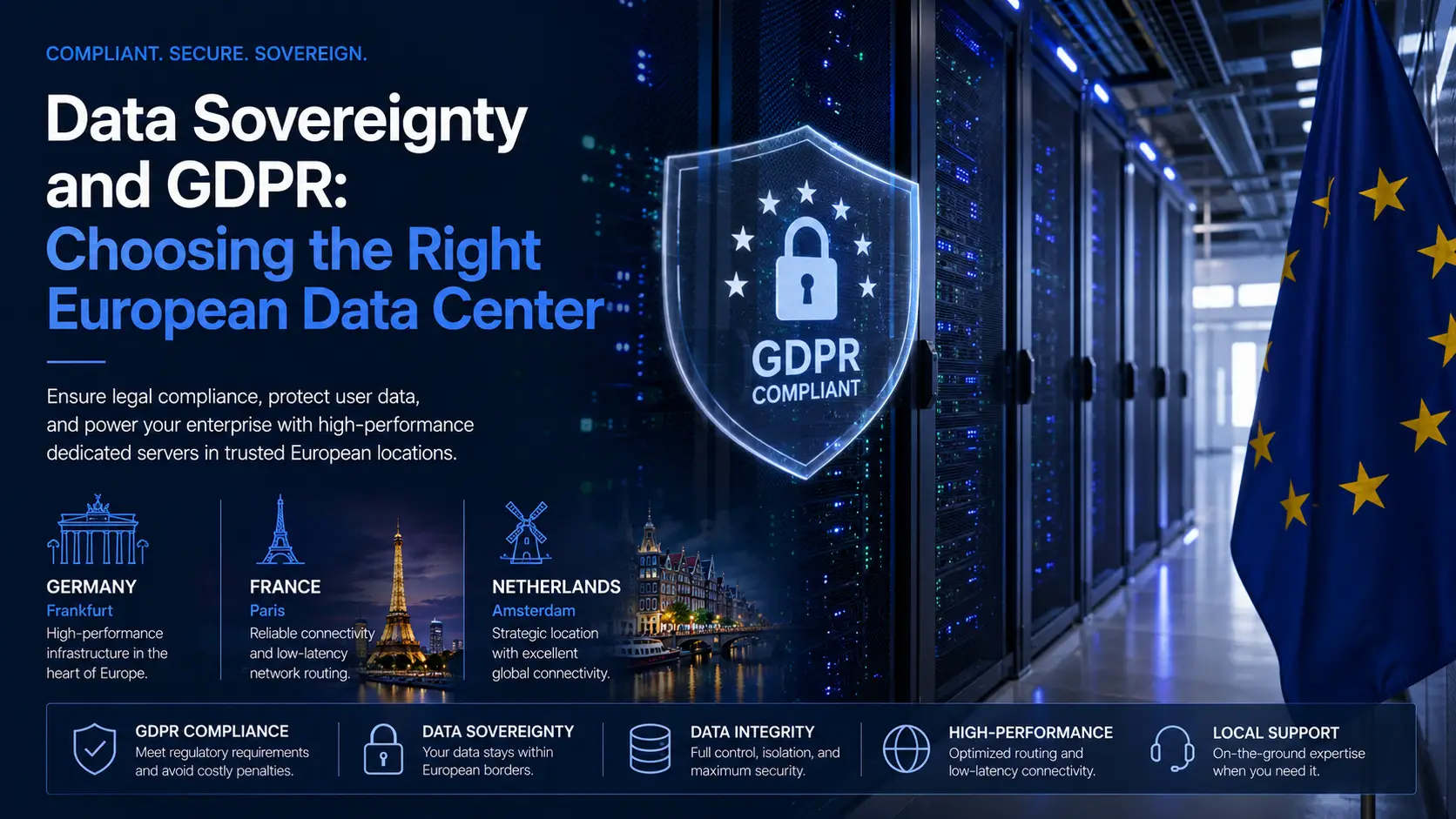
In an era defined by the General Data Protection Regulation (GDPR), multi-million-euro fines, and aggressive data protection authorities, architectural decisions carry immense legal weight. In this comprehensive guide, we will bridge the gap between legal compliance and IT infrastructure. We will answer the critical question of what data sovereignty actually means, dissect how the GDPR views data at rest, and guide you through choosing the optimal European jurisdiction—from a Germany dedicated server to a Paris bare metal server—to protect your business and your users.
What is Data Sovereignty?
To architect a compliant network, you must first understand the legal terminology. Often, the terms "data residency," "data localization," and "data sovereignty" are used interchangeably, but they represent very different concepts.
- Data Residency: The physical geographic location where an organization chooses to store its data, often for tax or operational purposes.
- Data Localization: A legal requirement dictating that data created within certain borders must remain within those borders.
- Data Sovereignty: The absolute legal reality that data is subject to the laws, legal frameworks, and subpoena powers of the country in which it is physically stored.
Why Data Sovereignty is a Global Battlefield
If your company is based in Berlin, but you store your customer database on a server located in Texas, your data is subject to United States law. Under legislations like the US CLOUD Act and the Patriot Act, US law enforcement and intelligence agencies can compel the US-based hosting provider to hand over your data, often without notifying you or requiring a European warrant.
This creates a massive legal conflict. The GDPR strictly prohibits European citizen data from being accessed by foreign governments without adequate, equivalent privacy protections. When you store EU data on US soil (or on servers owned by US companies), you are caught in a jurisdictional tug-of-war between American surveillance laws and European privacy rights.
The only definitive way to maintain absolute control over your digital assets and satisfy EU regulators is to assert your own data sovereignty by exclusively utilizing European-based infrastructure.
GDPR Compliance Regarding Physical Server Locations and Data at Rest
The General Data Protection Regulation (GDPR) is the most comprehensive data privacy law in the world. While it does not explicitly state "you must host your servers in Europe," the practical application of its rules makes hosting outside the EU a legal minefield.
Understanding Data at Rest
In IT security, data is categorized into three states: data in use (processing in RAM), data in transit (moving across the network), and data at rest (stored on physical HDDs, SATA SSDs, or NVMe drives).
When GDPR regulators audit a company, they focus heavily on data at rest. Why? Because data at rest is persistent. If a server is physically seized, or if a foreign government issues a subpoena to a data center operator, the data at rest is what is ultimately compromised.
The Impact of Schrems II and Cross-Border Transfers
For years, companies transferred data between the EU and the US using a legal framework called the "Privacy Shield." In 2020, the Court of Justice of the European Union (CJEU) struck down this framework in a landmark ruling known as Schrems II.
The court ruled that US surveillance laws do not offer EU citizens the level of privacy protection required by the GDPR. Consequently, transferring EU personal data at rest to a server physically located in the United States—or even to an EU-based server operated by a US cloud conglomerate—now requires complex, legally precarious Standard Contractual Clauses (SCCs) and supplementary security measures.
The Ultimate Safe Harbor: Physical European Bare Metal
How do you bypass the bureaucratic nightmare of Schrems II, SCCs, and Transfer Impact Assessments (TIAs)?
You eliminate the cross-border transfer entirely.
By leasing a dedicated bare metal server physically located within the borders of the European Economic Area (EEA), provided by an entity that is not subject to foreign surveillance laws, your data at rest never leaves the jurisdiction of the GDPR. This is the ultimate "safe harbor." It simplifies your legal audits, builds immense trust with privacy-conscious enterprise clients, and drastically reduces your corporate liability.
Evaluating European Jurisdictions: Choosing Your Data Center
While the GDPR acts as a baseline regulation across all 27 EU member states, individual countries have their own national implementations, supervisory authorities, and distinct infrastructural advantages. Choosing the right country for your server is a blend of navigating these national nuances and optimizing for network routing.
1. The German Fortress: Maximum Compliance and Financial Security
Germany is universally recognized as having the strictest data protection culture in the world. On top of the GDPR, Germany enforces the Bundesdatenschutzgesetz (BDSG - Federal Data Protection Act), which adds even tighter controls on employee data processing and the appointment of Data Protection Officers.
If your SaaS application deals with highly sensitive information—such as healthcare records, financial technology (FinTech) transactions, or government contracts—deploying a Germany dedicated server is the ultimate statement of compliance. It signals to your clients that you adhere to the most rigorous data sovereignty standards on the planet.
From a technical standpoint, a Frankfurt dedicated server is the crown jewel of European hosting. Frankfurt is the financial epicenter of the Eurozone, home to the European Central Bank. More importantly, it houses DE-CIX (Deutscher Commercial Internet Exchange), the largest internet exchange point in the world by peak traffic. Hosting your bare metal infrastructure in Frankfurt guarantees absolute legal compliance paired with unrivaled, ultra-low latency routing to the rest of Europe, Eastern Europe, and the Middle East.
2. The French Approach: Digital Sovereignty and Green Power
France has taken a highly vocal and aggressive stance on "Digital Sovereignty." The French government strongly advocates for European technological independence, actively pushing enterprises to move away from American hyperscalers and toward sovereign, bare-metal infrastructure. The French data protection authority, the CNIL, is notoriously active and frequently levies massive fines against companies that mishandle data transfers.
Securing a France dedicated server ensures you are aligned with the CNIL's rigorous interpretations of the GDPR. Furthermore, France offers a unique infrastructural advantage: its power grid.
Because France generates the vast majority of its electricity from nuclear power, it has one of the lowest carbon-intensity power grids in the developed world. As corporate Environmental, Social, and Governance (ESG) requirements become stricter, deploying a Paris bare metal server allows you to claim a highly sustainable, eco-friendly infrastructure footprint. Network-wise, Paris serves as a vital routing hub connecting the UK to the Mediterranean and North Africa.
3. The Dutch Gateway: Privacy and Unrivaled Connectivity
The Netherlands provides a pragmatic balance. The Dutch Data Protection Authority (Autoriteit Persoonsgegevens) strictly enforces the GDPR, but the country's historic position as an international trading hub translates into a highly business-friendly digital environment.
A Netherlands dedicated server is widely considered the standard for general-purpose European SaaS platforms, streaming architectures, and multi-national corporations. Amsterdam is home to AMS-IX (Amsterdam Internet Exchange). The sheer density of subsea and terrestrial fiber converging in Amsterdam means that bandwidth is incredibly abundant and cost-effective.
By locating your data at rest in Amsterdam, you secure the data sovereignty required to pass GDPR audits, while simultaneously gaining access to network transit that can easily serve 100% of the European continent without breaking a sweat.
Navigating the Post-Brexit Landscape: The UK Factor
When discussing European data sovereignty, the United Kingdom requires a special mention. Following Brexit, the UK is no longer part of the European Union, and therefore, data stored there is technically outside the immediate jurisdiction of the EU GDPR.
However, the UK has enshrined the regulations into domestic law, known as the "UK GDPR." More importantly, the European Commission has granted the UK an "Adequacy Decision." This means the EU legally recognizes that the UK's data protection standards are fundamentally equivalent to the GDPR.
Therefore, data can flow freely between the EU and the UK without the need for complex legal safeguards. For companies that heavily target the British consumer market but still need to serve the continent, deploying infrastructure across London and European locations is a perfectly viable, legally compliant strategy. London remains one of the most critical financial and network transit hubs in the world, serving as the primary bridge for transatlantic fiber cables connecting Europe to the East Coast of the United States.
Hardware Reliability: The Unspoken Compliance Metric
When organizations discuss GDPR, they usually focus on Article 5 (principles of processing) or Article 15 (the right of access). However, system architects must pay extremely close attention to Article 32: Security of Processing.
GDPR Article 32 mandates that data controllers must implement technical measures to ensure the "ongoing confidentiality, integrity, availability, and resilience of processing systems and services."
If your server's hardware fails, taking your application offline for 24 hours, you have failed the "availability" requirement. If a faulty component corrupts a database entry, changing a user's financial record without authorization, you have failed the "integrity" requirement. Under the GDPR, an infrastructure failure is a compliance failure.
This is why compliant enterprise architecture cannot be built on consumer-grade hardware. It requires bare metal servers specifically engineered for resilience.
Protecting Data Integrity with ECC RAM
The most vulnerable point in your server's data pipeline is the Random Access Memory (RAM). As data moves from the NVMe storage drive into RAM to be processed by the CPU, it is exposed to background radiation and electrical interference. These microscopic anomalies can flip a single bit of data (changing a 0 to a 1).
In a standard consumer PC, a "bit flip" might cause a video game to crash. On a database server, a bit flip is permanently written to the storage drive, resulting in silent data corruption. This violates the integrity clause of the GDPR.
To achieve true enterprise compliance, your European dedicated servers must be equipped with ECC RAM (Error-Correcting Code Memory). ECC RAM contains specialized microchips that actively monitor the data passing through the memory modules in real-time. If it detects a flipped bit, the ECC chip mathematically recalculates and corrects the error before it can be processed by the CPU or saved to the disk.
By mandating ECC RAM across your bare metal fleet, you mathematically guarantee the integrity of your users' data at rest and in use, providing verifiable proof to regulators that you have taken every technical precaution under Article 32.
The Hybrid Sovereignty Strategy
For large-scale applications, a single server location is rarely sufficient. A robust compliance and disaster recovery strategy involves a multi-node European deployment.
A highly compliant "Hybrid Sovereignty" architecture might look like this:
- The Primary Database Vault: You deploy a cluster of Germany dedicated servers utilizing RAID 10 NVMe drives and massive ECC RAM allocations. Because this server holds the critical, persistent data at rest, locking it within the strict confines of Frankfurt's legal jurisdiction ensures maximum GDPR protection.
- The Application / Edge Nodes: You deploy stateless application servers using a Netherlands dedicated server or a Paris bare metal server. These servers process user requests and cache data but do not store the master database. This allows you to leverage the immense bandwidth of Amsterdam or the green power of Paris, while ensuring the core data repository remains completely secure in Germany.
Conclusion: Infrastructure is Policy
The public cloud promised a world where infrastructure was invisible, but the enforcement of global privacy laws has proven that physical hardware is more relevant than ever. Data sovereignty is not a theoretical concept; it is the legal reality of where your physical disk drives are bolted into their racks.
You cannot achieve GDPR compliance as an afterthought, nor can you reliably achieve it by outsourcing your legal liability to foreign hyperscalers. Compliance must be baked directly into your infrastructure architecture.
By taking ownership of your environment and strategically deploying bare metal hardware within the European Economic Area—whether anchoring your finances on a Frankfurt dedicated server, leveraging the green energy of a France dedicated server, or capturing global transit through a Netherlands dedicated server—you transform data privacy from a legal liability into a powerful, marketable competitive advantage.
 Recent Topics for you