The journey of a growing digital business often follows a predictable, and ultimately expensive, infrastructure trajectory. It usually begins with a single Virtual Private Server (VPS) in a public cloud. As traffic grows, the engineering team provisions another VPS for the database, another for a caching layer, and a few more for microservices.
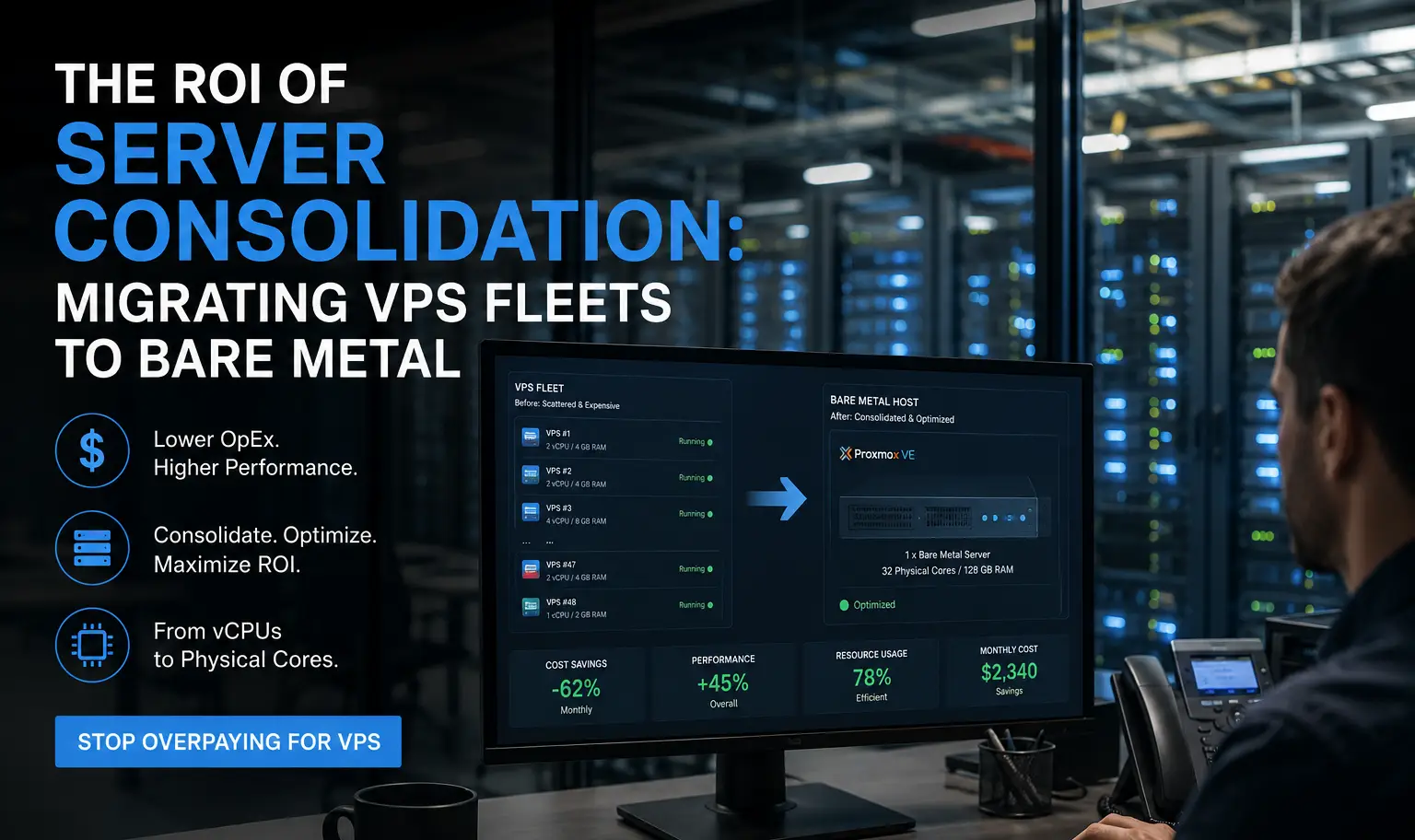
Fast forward two years, and the company is managing a sprawling, fragmented fleet of 40 or 50 different VPS instances across multiple cloud providers.
While public cloud environments market themselves on the premise of "infinite scalability," the financial reality for established businesses is often a catastrophic explosion in monthly operational expenditures. You are no longer paying just for compute power; you are paying the public cloud provider's massive markup for the convenience of virtualization.
The solution to this cloud trap is server consolidation. By migrating your scattered VPS fleet onto a single, high-core-count bare metal server using enterprise hypervisors like Proxmox or VMware, you can drastically reduce your monthly bill while simultaneously increasing your application's performance.
In this comprehensive guide, we will break down the financial and technical ROI of migrating from a public cloud VPS fleet to localized bare metal infrastructure.
The Financial Trap of the Public Cloud
To understand the ROI of consolidation, we must first understand how cloud providers structure their pricing, specifically concerning the shift between OpEx (Operational Expenditure) and CapEx (Capital Expenditure).
OpEx vs. CapEx in Cloud Computing
Historically, IT infrastructure was a CapEx game. A company would spend $50,000 upfront to buy physical servers, rack them in a data center, and depreciate the asset over five years. The public cloud revolutionized this by shifting infrastructure entirely to OpEx. You pay nothing upfront, but you pay a premium hourly or monthly rate for the resources you consume.
For startups with unpredictable growth, a 100% OpEx model is fantastic. However, for established businesses with predictable baseline workloads, staying entirely in the public cloud's metered OpEx model is financially toxic.
When you rent a VPS, you are paying a heavy premium for the provider's proprietary management layer, their branding, and their network egress fees. By transitioning to a leased bare metal server, you retain the benefits of OpEx (no massive upfront hardware purchase) but shift to a fixed-cost OpEx model. You pay a flat, predictable monthly rate for the entire physical machine, bypassing the cloud provider's exorbitant retail markup on compute and bandwidth.
The Illusion of Cloud Performance: vCPUs vs. Physical Cores
Beyond the financial savings, server consolidation solves a massive, often misunderstood technical bottleneck: the difference between a vCPU and a physical core.
When you lease a "4 vCPU" cloud VPS, you are not getting four physical processors.
What is a vCPU?
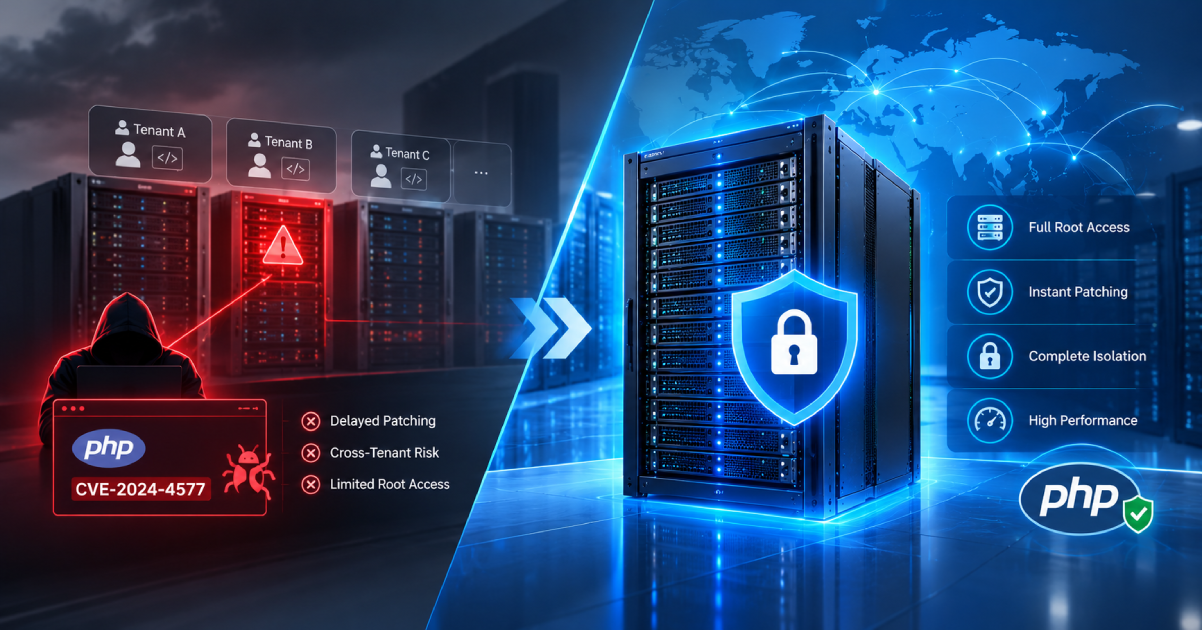
A virtual CPU (vCPU) is simply a thread, or a time-sliced portion of a physical core, allocated to your virtual machine by the cloud provider's hypervisor. Public cloud providers operate on a business model of oversubscription. They might have a physical server with 32 cores, but they will sell 128 vCPUs on that machine, betting that not every customer will use their CPU at 100% capacity simultaneously.
The Problem of Resource Contention
This oversubscription leads to resource contention—often referred to as the "noisy neighbor" effect. If another VPS on your shared physical host suddenly runs a massive database compilation, it consumes the hardware's actual processing cycles and memory bandwidth. Your VPS, despite paying for "4 vCPUs," is forced to wait in line. This introduces micro-stutters, CPU steal time, and unpredictable application latency.
The Bare Metal Advantage
When you lease a bare metal server, you own the entire silicon die. There is no oversubscription. If you lease a machine with 32 physical cores, you have 32 physical cores at your absolute disposal. One physical, dedicated core can easily perform the work of 3 to 4 standard public cloud vCPUs because it is not fighting through a shared hypervisor layer or waiting in queue for CPU cycles.
The Architecture of Consolidation: Type 1 Hypervisors
Migrating to bare metal does not mean you have to abandon the flexibility of virtual machines or containers. The secret to modern server consolidation is installing your own Type 1 Hypervisor.
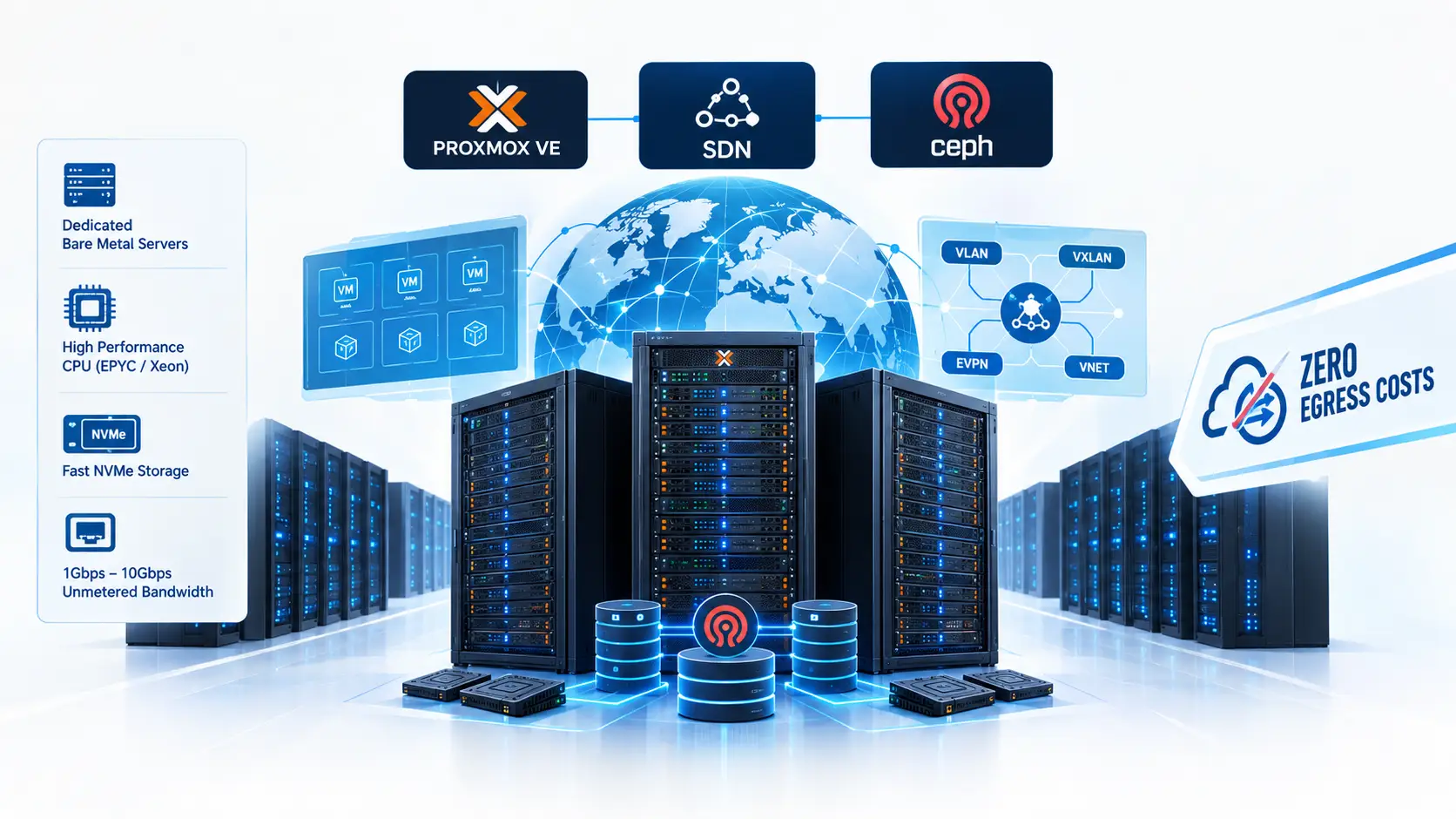
A Type 1 Hypervisor (also known as a bare-metal hypervisor) is an operating system designed explicitly to run virtual machines directly on the server's hardware. The most popular enterprise choices are Proxmox VE (open-source and highly popular for Linux environments) and VMware ESXi.
How Consolidation Works
Instead of renting 20 separate VPS instances from a cloud provider, you lease one massive dedicated server. You install Proxmox on the bare metal. Through the Proxmox web interface, you can instantly carve up your massive pool of dedicated physical resources into your own private VPS fleet.
You can spin up:
- A VM with 8 cores and 32GB of RAM for your primary database.
- A VM with 4 cores and 8GB of RAM for your web server.
- An LXC container with 2 cores for your Redis cache.
Because you control the hypervisor, you dictate the oversubscription rules. You can isolate specific physical CPU cores and pin them to your most critical VMs, ensuring zero resource contention. Furthermore, traffic between these VMs happens internally over the hypervisor's virtual switch at the speed of the physical RAM, avoiding external network latency completely.
Calculating the ROI: Sizing Your Hardware
The key to a successful migration is choosing a server with enough computational density to comfortably house your entire fleet. Modern bare metal processors are incredibly powerful, allowing for consolidation ratios that were impossible a decade ago.
Scaling Up: 4 to 32 CPU Cores
For small to medium-sized fleets (e.g., consolidating 10 to 15 standard web and application VPS instances), a single-socket server is often more than enough. Processors in the 4 to 32 CPU Cores range, such as standard AMD Ryzen or Intel Xeon E-series chips, provide a fantastic balance of high clock speeds and sufficient threading.
If you are currently spending $800 a month on a dozen scattered cloud instances, you can often consolidate all of them onto a single 16-core or 24-core dedicated server for half the price, while experiencing a noticeable performance uplift due to the elimination of noisy neighbors.
Enterprise Consolidation: 8 Processor Count Topologies
For enterprise applications, SaaS platforms, or massive database clusters currently utilizing dozens of high-memory cloud instances, you must look at multi-socket architectures.
High-end enterprise servers featuring dual or quad-socket configurations (totaling up to an 8 Processor Count architecture or utilizing massive 128-core AMD EPYC deployments) are designed specifically for extreme virtualization density. These machines can support terabytes of ECC RAM and hundreds of PCIe lanes for NVMe storage arrays. Consolidating a $10,000/month public cloud footprint onto a $1,500/month dual-socket enterprise server yields an operational ROI that completely transforms a company's profit margins.
Geographic Strategy: Where to Deploy Your Consolidated Hub
When you consolidate your infrastructure, the physical location of your bare metal server becomes paramount. Because all your primary services will now live on this machine (or a highly available cluster of these machines), it must be placed strategically to serve your target demographic with the lowest possible latency.
1. The North American Anchor: Toronto
For businesses serving the United States and Canada, selecting a Canada dedicated server is a highly strategic financial and technical move.
Toronto is a Tier-1 global tech hub. Deploying Toronto dedicated hosting places your consolidated infrastructure on the edge of the US border, providing sub-20ms latency to massive financial and consumer hubs like New York and Chicago. Furthermore, due to favorable exchange rates and lower commercial power costs (often generated by massive hydroelectric grids), Canadian data centers frequently offer more competitive pricing on high-end bare metal hardware than equivalent facilities in Silicon Valley or Manhattan.
2. The European Gateway: The United Kingdom
If your business is transitioning from a scattered European cloud deployment, centralization in the UK is the logical next step.
When you buy dedicated server UK infrastructure (specifically in London facilities), you are plugging your consolidated hypervisor directly into the epicenter of European telecommunications. London provides unparalleled subsea fiber connectivity across the Atlantic to North America, and ultra-low latency routes directly into Frankfurt, Paris, and Amsterdam. A massive Proxmox host in London can effectively serve your entire EMEA (Europe, Middle East, and Africa) user base from a single, highly manageable geographic point.
3. Capturing the APAC Market: Japan
For organizations serving the booming Asian-Pacific enterprise market, public cloud costs can be notoriously high due to regional monopolies and expensive transit bandwidth.
Consolidating your APAC fleet onto a single Bare metal server Japan circumvents these high costs. Tokyo is the primary routing hub for internet traffic in the region. By deploying a dense, multi-core virtualization host in Tokyo, you provide lightning-fast, localized application performance to Japanese enterprises while serving as a high-speed gateway to South Korea, Taiwan, and the broader Southeast Asian market.
Mitigating Risk: High Availability (HA) in Consolidation
The most common objection to server consolidation is the "all eggs in one basket" fear. If you move 30 VPS instances onto a single physical server, what happens if that physical server's motherboard fails?
This is where the true power of enterprise hypervisors comes into play. You don't just build one basket; you build a High Availability (HA) cluster.
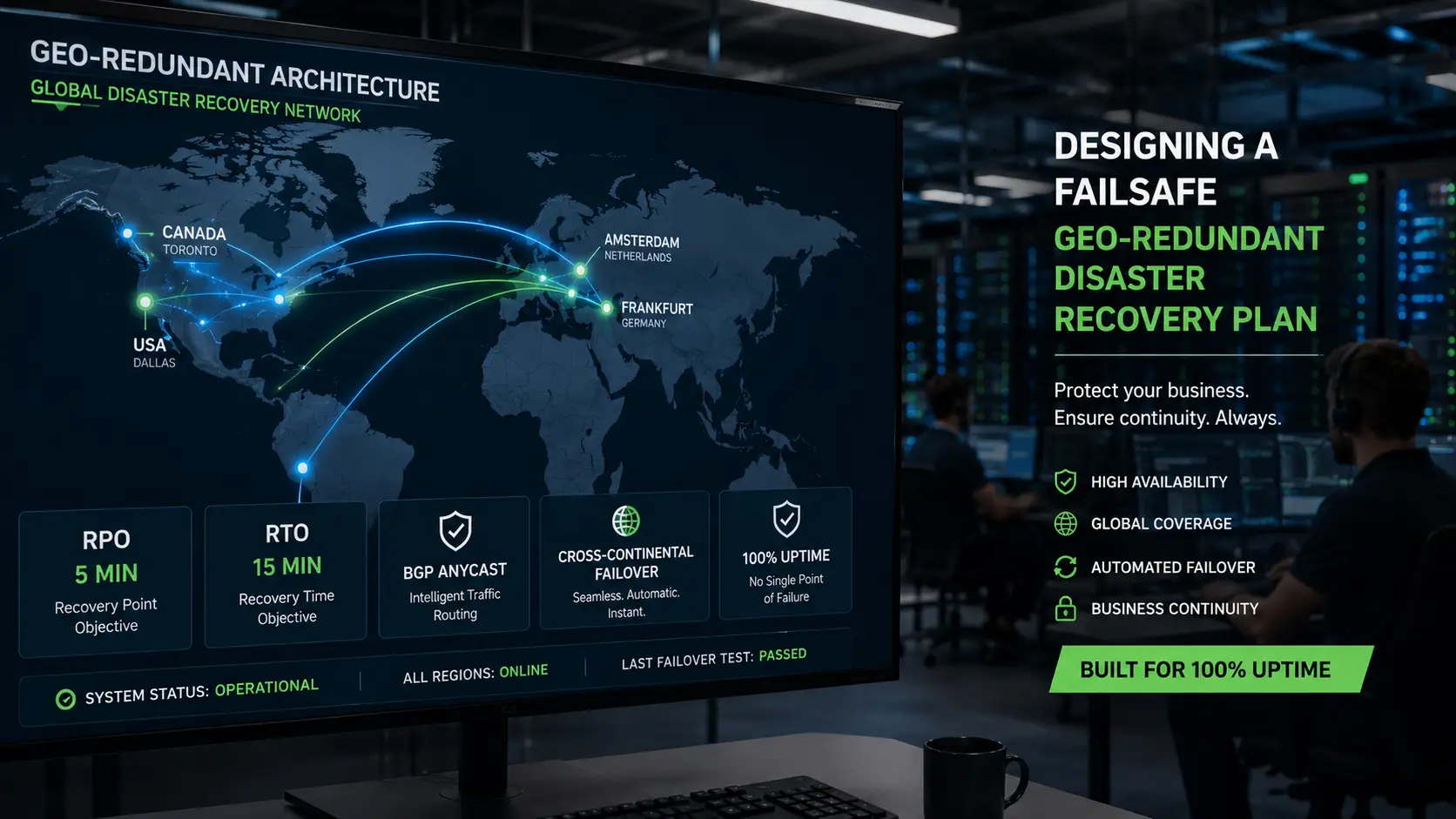
Instead of one massive server, a best-practice consolidation strategy involves leasing two or three slightly smaller bare metal servers in the same data center. You install Proxmox or ESXi on all three and cluster them together. Using distributed storage technologies like Ceph or VMware vSAN, your data is synchronously replicated across all the physical nodes.
If Physical Server A suffers a hardware failure, the hypervisor cluster instantly detects it. Within seconds, the virtual machines that were running on Server A are automatically rebooted and spun up on Server B and Server C.
Even when leasing three bare metal servers to create an enterprise-grade HA cluster, the monthly fixed cost is routinely far lower than running 40 unclustered, metered VPS instances in the public cloud.
Conclusion
The public cloud is an incredible tool for prototyping, unpredictable scaling, and highly specialized managed services. However, for baseline, predictable workloads, renting fragmented virtual machines is an incredibly inefficient use of IT budgets.
Server consolidation is the ultimate infrastructure optimization strategy. By migrating your scattered VPS fleets to localized, high-performance bare metal servers running your own hypervisors, you regain absolute control over your environment.
You eliminate the financial unpredictability of metered OpEx, eradicate the performance drain of resource contention and oversubscribed vCPUs, and build a streamlined, highly profitable architecture. Whether anchoring your North American operations with Toronto dedicated hosting, dominating Europe with a UK dedicated server, or capturing the APAC market with a Bare metal server Japan, consolidation on bare metal is the defining mark of a mature, financially optimized engineering team.
 Recent Topics for you