In the world of High-Frequency Trading (HFT) and algorithmic trading, the old adage "time is money" is a gross understatement. For modern financial institutions, hedge funds, and independent quantitative traders, time isn't just money—time is survival. In an environment where trading decisions are executed in fractions of a second, the difference between a highly profitable trade and a devastating loss is often measured in milliseconds, and increasingly, microseconds.
When multiple algorithms detect the same market inefficiency simultaneously, the race is on. The algorithm that reaches the exchange's matching engine first claims the profit (the alpha). Everyone else is left dealing with adverse price changes. This is why software alone is no longer enough. The code your quant writes is only as good as the physical infrastructure it runs on.
In this comprehensive guide, we will explore the critical hardware and network strategies required to build a world-class HFT architecture. From selecting the right geographic locations to leveraging high-frequency CPUs, this post will detail how the right infrastructure can make or break your algorithmic trading strategy.
The Physics of Trading: Network Latency and Fiber Routes
To understand HFT infrastructure, you must first understand the physics of data transmission. Data travels over fiber optic cables as pulses of light. While light is incredibly fast, it is still bound by the laws of physics. In a vacuum, light travels at approximately 300,000 kilometers per second. However, inside the glass core of a fiber optic cable, it slows down by about 30%, traveling at roughly 200,000 kilometers per second.
This physical limitation means that distance inherently equals time.
If your trading algorithm is running on a server in California, but the exchange you are trading on is in New York, your data must travel across the country. That physical distance introduces a theoretical minimum latency of around 20 to 25 milliseconds round-trip. In the context of HFT, 25 milliseconds is an absolute eternity. In that time, a competing algorithm hosted closer to the exchange could have executed a trade, analyzed the result, and executed another trade.
The Importance of Optimized Fiber Routes
Latency is not just about the straight-line distance; it is about the actual path the cable takes. Standard internet traffic bounces through multiple public routers, switches, and internet service providers (ISPs). Each "hop" adds processing time, introducing jitter (unpredictable latency).
HFT infrastructure relies on optimized, direct fiber routes. Financial institutions invest millions in finding the straightest possible physical paths between major data centers. When designing your architecture, you must ensure your server provider utilizes premium transit networks and direct peering agreements with major financial networks, minimizing the number of hops your data takes before hitting the exchange.
Understanding Slippage and the Cost of Being Second
Why does a millisecond matter so much? The answer lies in a concept called slippage.
What is Slippage in Trading?
Slippage occurs when there is a difference between the expected price of a trade and the price at which the trade is actually executed.
Imagine your algorithm spots an opportunity to buy 1,000 shares of a stock at $50.00. It sends the buy order. However, because your server is poorly optimized, your order takes 15 milliseconds to reach the exchange. In the preceding 14 milliseconds, a faster competitor bought the available shares at $50.00. The market price instantly adjusted to $50.05. By the time your order arrives, the matching engine fills it at the new, higher price.
That $0.05 difference is slippage. On a 1,000-share order, you just lost $50 in potential profit due to pure network latency. Multiply that by tens of thousands of trades a day, and latency becomes a massive systemic risk to your portfolio.
Whether you are trading equities, futures, or utilizing Forex algorithms, minimizing slippage is the primary goal of HFT infrastructure. The only way to effectively eliminate slippage is through strategic geographic colocation.
Geographic Strategy: The Holy Trinity of Financial Hubs
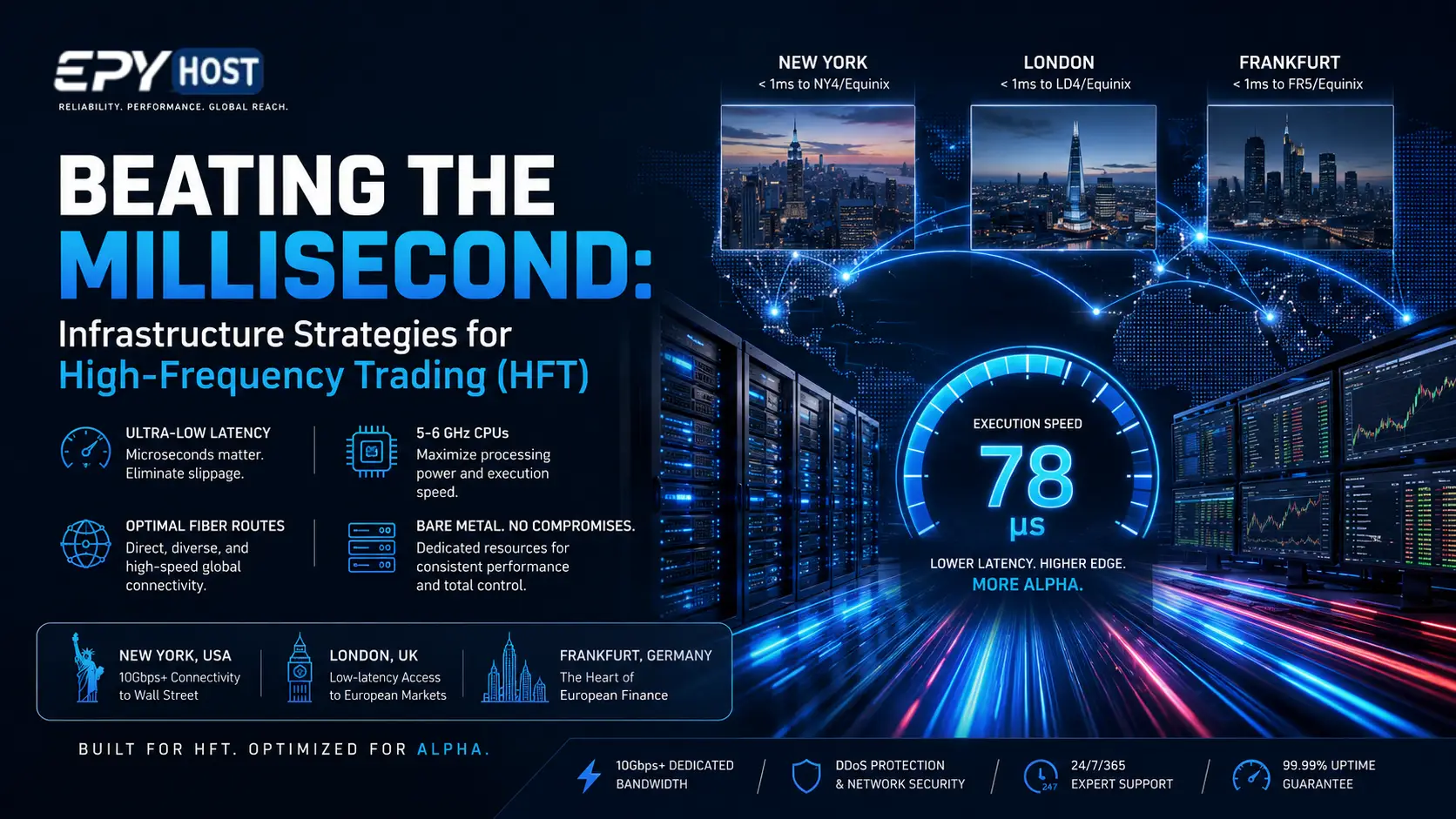
To beat the speed of light, you cannot make light travel faster—you must shorten the distance it has to travel. This practice is known as colocation. By placing your trading server in a data center that is physically adjacent to (or even inside the same building as) the financial exchange's matching engine, you reduce your network latency to near zero.
For global algorithmic trading, three cities represent the core pillars of the financial world. If you are serious about HFT, your infrastructure must be rooted in these locations.
- 1. New York / New Jersey: The Epicenter of Equities
The United States stock market is the most liquid in the world, but the matching engines for the NYSE and NASDAQ are not actually on Wall Street. They are located in massive data centers in New Jersey (such as Mahwah, Carteret, and Secaucus). To compete in US equities and options, you must deploy a New York bare metal server situated as close to these New Jersey hubs as possible. A bare metal server in this region ensures you are positioned on the most critical fiber routes on the Eastern Seaboard, allowing you to ingest market data and execute trades with sub-millisecond precision. - 2. London: The Forex Capital of the World
London is the undisputed king of the global foreign exchange (Forex) market. Because Forex is decentralized, liquidity is spread across multiple institutional bank networks and electronic communication networks (ECNs). Many of the world's largest Forex matching engines, such as LMAX and Currenex, are housed in data centers in and around London (specifically Slough). If your algorithms are trading EUR/USD, GBP/JPY, or other major currency pairs, latency will destroy your edge. Securing London dedicated hosting places your hardware directly at the crossroads of the global Forex network. Furthermore, London serves as the primary transatlantic gateway to New York, ensuring that cross-market arbitrage strategies are executed over the shortest, fastest submarine fiber routes available. - 3. Frankfurt: The Gateway to European Derivatives
While London dominates Forex, Frankfurt is the heavyweight champion of European derivatives and equities. Frankfurt is home to the Deutsche Börse and the Eurex exchange, one of the largest futures and options markets in the world. Deploying a Frankfurt dedicated server is a non-negotiable requirement for quants trading European futures, DAX index options, or conducting arbitrage between European and American markets. Furthermore, Frankfurt is home to DE-CIX, the world's largest internet exchange point by peak traffic, providing unparalleled connectivity to the rest of the European continent and Asia.
The Need for Speed: Ingesting the Tick with 10Gbps Networks
While latency (the time it takes data to travel) is critical, it is only half of the network equation. The other half is bandwidth (the volume of data that can travel at once).
In modern financial markets, exchanges broadcast market data via "Tick data" feeds. A tick represents a single change in the price or volume of a security. During highly volatile market events—such as a central bank interest rate announcement, a non-farm payroll report, or a sudden geopolitical crisis—the volume of tick data explodes. The market depth updates thousands of times per second.
If your server's network port cannot handle the sheer volume of incoming data, packets will be queued or dropped. This creates a synthetic latency bottleneck. Your physical distance to the exchange won't matter if your network card is choking on the data feed.
To survive these micro-bursts of market activity, a standard 1Gbps connection is often insufficient for institutional-grade algorithms. Deploying a 10gbps dedicated server USA ensures that your infrastructure has a massive pipeline, capable of absorbing explosive spikes in market data without breaking a sweat. A 10Gbps uplink allows your trading software to process the entire market order book in real-time, completely uninterrupted, giving your algorithm the complete picture of the market before it makes a decision.
Processing the Tick: The Critical Role of High-Frequency CPUs
Once the market data successfully travels across the optimized fiber route, passes through your 10Gbps network interface, and enters your server, the race shifts from the network to the silicon. This is the "tick-to-trade" latency—the time it takes your server to receive the data, run the complex algorithmic math, and send the order out.
When architects design general-purpose web servers or cloud environments, they usually prioritize CPU core count. They want 32, 64, or 128 cores to handle thousands of simultaneous, small requests from web traffic. HFT flips this logic completely upside down.
Why Clock Speed Trumps Core Count
Most algorithmic trading applications are highly sequential. The code must process Tick A, evaluate it, update the model, and then move to Tick B. Because the math must be done in a strict, chronological order to maintain the integrity of the time-series data, it is incredibly difficult to split this workload across multiple CPU cores.
Therefore, for trading servers, single-threaded performance is king.
You do not need 64 slow cores; you need a smaller number of the absolute fastest cores in existence. The metric that dictates this speed is the CPU's base and boost clock frequency, measured in Gigahertz (GHz).
When building an HFT stack, you must actively seek out processors designed for extreme burst speeds. Standard enterprise processors often hover around 2.5 GHz to 3.5 GHz to conserve power and reduce heat in dense data centers. For an algorithmic trading server, this is entirely inadequate.
To minimize tick-to-trade latency, you must utilize 4.5-6 GHz CPU Frequency bare metal servers. Processors capable of sustaining frequencies above 4.5 GHz—such as highly binned Intel Core i9 processors, specialized Intel Xeon W-series chips, or top-tier AMD Ryzen processors—can execute your trading logic exponentially faster than standard enterprise silicon. Every extra Gigahertz of clock speed physically reduces the microsecond delay in your algorithm's execution loop, ensuring your order hits the wire faster than the competition.
The Bare Metal Mandate: Why Virtualization Fails in HFT
You might be wondering why financial institutions spend so much on dedicated infrastructure rather than simply spinning up virtual machines (VMs) in a public cloud like AWS or Azure.
The answer is virtualization overhead.
In cloud hosting, a layer of software called a hypervisor sits between the physical hardware and your virtual server. Every time your virtual server wants to send a network packet or write to memory, that request must be translated and routed through the hypervisor. This process introduces microsecond delays and, more importantly, jitter. Cloud environments suffer from the "noisy neighbor" effect, where another user on the same physical hardware might suddenly consume resources, causing a micro-stutter in your VM's performance.
In algorithmic trading, consistency is just as important as raw speed. You cannot afford to miss a trade because a hypervisor decided to pause your CPU cycle for 3 milliseconds.
This is why HFT demands bare metal servers. By leasing dedicated hardware, you eliminate the hypervisor completely. Your trading application interacts directly with the physical CPU, the physical RAM, and the physical Network Interface Card (NIC). There are no noisy neighbors, no shared resources, and no artificial bottlenecks.
Advanced Hardware Tuning: Taking it a Step Further
For the elite echelon of HFT, securing a high-frequency bare metal server is just the baseline. System administrators will then heavily tune the operating system to squeeze out every last nanosecond:
- Kernel Bypass: Utilizing specialized network cards (like Solarflare) and technologies like DPDK (Data Plane Development Kit) allows incoming network packets to bypass the Linux kernel entirely and go straight to the trading application in user space, saving precious microseconds.
- CPU Pinning: Locking the trading application to specific physical CPU cores to prevent the operating system from migrating the process, which would cause cache misses and latency spikes.
- Disabling C-States: Turning off power-saving features in the BIOS so the CPU never "sleeps," ensuring it is always running at its maximum 4.5-6 GHz frequency and ready to process a tick instantly.
Conclusion: Building the Ultimate HFT Stack
The financial markets are the ultimate proving ground for computer science. They are a zero-sum game where technology directly dictates profitability. As markets become increasingly automated, the barrier to entry continues to rise, and the margin for error shrinks.
Successfully deploying an algorithmic trading strategy requires a holistic approach to infrastructure architecture:
- Eliminate physical distance: Deploy a New York bare metal server for equities, secure London dedicated hosting for Forex, and leverage a Frankfurt dedicated server for European derivatives.
- Ensure massive capacity: Utilize a 10gbps dedicated server USA to guarantee your systems never choke on explosive market data spikes during high-volatility events.
- Process at the speed of thought: Ditch high-core-count processors in favor of hyper-fast 4.5-6 GHz CPU Frequency bare metal servers to execute your single-threaded trading logic instantly.
- Demand absolute isolation: Insist on bare metal hardware to bypass virtualization overhead and guarantee deterministic, jitter-free performance.
By combining strategic geographic colocation, massive network throughput, and raw, high-frequency compute power, you can effectively eliminate slippage. In the relentless race to beat the millisecond, this infrastructure strategy is not just an operational cost—it is the very engine of your competitive advantage.
 Recent Topics for you