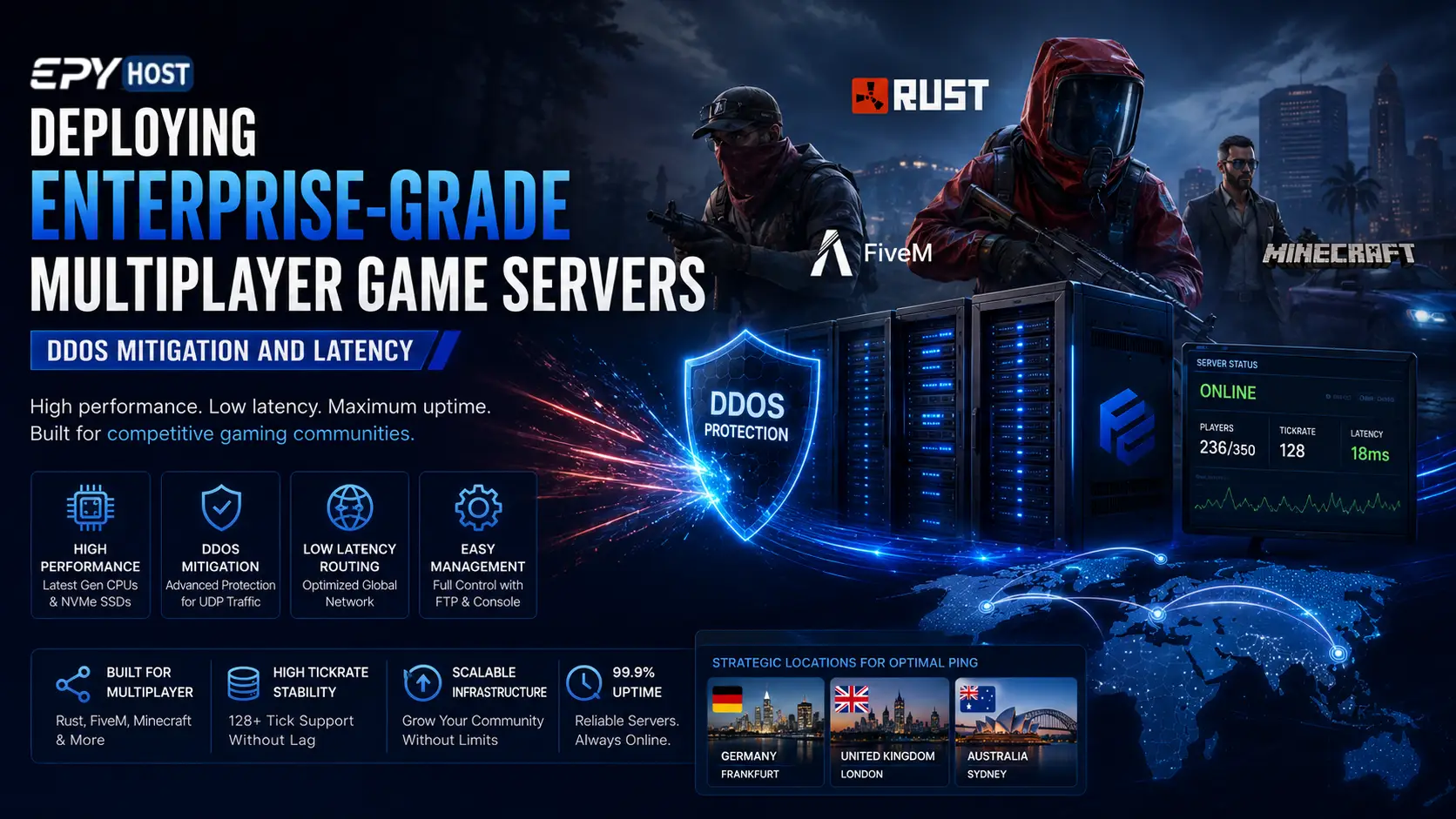
The multiplayer gaming landscape has evolved drastically from the days of peer-to-peer hosting and lightweight lobby shooters. Today, community-driven servers for massive open-world games like Rust, heavily modded Minecraft, and Grand Theft Auto V roleplay (FiveM) operate more like digital municipalities than simple game sessions. These servers host hundreds of concurrent players, persist thousands of dynamic world entities, and process millions of database interactions every single hour.
Running a successful gaming community is now a competitive, monetized enterprise. If your server is offline, or if your players are rubber-banding across the map, your community will abandon your server for a competitor in a matter of minutes.
To survive and scale in this environment, community founders and system administrators must move past consumer-grade shared hosting and embrace enterprise infrastructure. In this deep dive, we will explore the critical architecture behind high-performance game servers. We will break down the hardware required to prevent server-side lag, dissect the unique challenges of routing internet traffic for gamers, and explain how to survive the relentless barrage of DDoS attacks that plague the industry.
The Anatomy of Server Lag: Tick Rate vs. Network Ping
When a player complains about "lag," they are usually conflating two entirely different technical issues. To architect a high-performance game server, you must address both sides of the latency equation: Network Latency (Ping) and Server Processing Time (Tick Rate).
Network Latency (The Physical Distance)
Ping is the measurement of time it takes for a data packet to travel from the player's computer to your server and back. Because data is bound by the physical limits of fiber optic cables and routing hops, distance is the primary enemy.
If a player in London connects to a server in Los Angeles, they will experience a baseline physical latency of over 130 milliseconds. In a fast-paced FPS or a high-stakes survival game like Rust, 130ms is a severe disadvantage. The player's client is constantly out of sync with the server's reality, leading to "ghost hits" and delayed hit registration.
Server Processing Time (The Hardware Bottleneck)
Tick Rate, measured in Ticks Per Second (TPS), is how many times per second the game server calculates the entire world state—updating player positions, calculating bullet trajectories, and executing NPC AI. A healthy Minecraft server runs at 20 TPS. High-performance shooters run at 60 to 128 TPS.
If your server hardware is too weak to process the massive amount of game logic within the required millisecond window, the Tick Rate drops. When a Minecraft server drops to 10 TPS, the game engine physically slows down. Blocks reappear after being mined, and players rubber-band backward, regardless of how fast their internet connection is.
To eliminate lag, you need localized geographic placement to lower the ping, paired with extreme hardware performance to maintain the tick rate.
Geographic Dominance: Placing Hardware Near the Player
The most effective way to guarantee a premium experience is to deploy your infrastructure as close to your player base as physically possible.
Centralizing the European Player Base
Europe is an incredibly dense market for PC gaming. To capture this demographic, central routing is critical. Deploying a Germany dedicated server—specifically in routing hubs like Frankfurt—provides the ultimate geographic anchor. Frankfurt houses DE-CIX, the largest internet exchange in the world. A Bare metal server Germany guarantees that players from France, Poland, Italy, and Scandinavia all connect with sub-40ms ping, ensuring a perfectly level competitive playing field.
For communities focusing heavily on the British Isles or looking to bridge the gap with East Coast American players, a UK dedicated server in London provides excellent transatlantic peering while keeping local UK players comfortably under 15ms.
Emerging European Tech Hubs
When scaling your community, looking beyond traditional hubs can provide unique routing advantages. Deploying infrastructure in specialized zones like Tallinn Gaming data centers provides hyper-optimized routes to the Nordic and Baltic regions, which boast some of the most highly engaged PC gaming demographics in the world.
Conquering the Oceania Challenge
Australia is a notoriously difficult region for game hosting. The physical distance from the rest of the world, combined with expensive domestic bandwidth, often forces Australian players to endure terrible latency on Asian or US servers.
To build a localized community here, localized hardware is non-negotiable. While the market is historically expensive, utilizing a Cheap dedicated server Australia in a premier data center (like Sydney) ensures your localized player base enjoys single-digit ping. Modern enterprise providers now offer highly competitive pricing in Oceania, proving that "cheap" can refer to operational efficiency rather than compromised hardware quality.
Hardware that Powers the Worlds: Single-Thread Supremacy
The most common mistake community admins make is buying standard enterprise servers with massive core counts (e.g., dual 24-core Xeon processors at 2.2 GHz) and expecting phenomenal gaming performance.
Why Core Count Doesn't Matter in Gaming
Almost all major game server engines—including the Source Engine (CS2, Garry's Mod), Unity (Rust), and the custom architecture of FiveM—are overwhelmingly single-threaded.
This means the primary game loop (the process calculating physics, hit registration, and entity movement) operates on a single CPU core. It cannot easily divide this complex, chronological math across 10 different cores. Therefore, having 48 slow cores is useless; you need a smaller number of the absolute fastest cores in existence.
When exploring Gaming dedicated server features, your primary metric must be Clock Speed. Bare metal servers utilizing high-frequency processors (like overclocked Intel Core i9s or AMD Ryzen 9s pushing 5.0+ GHz) are the industry standard. These chips chew through the primary game loop exponentially faster than traditional enterprise silicon, guaranteeing a flawless 60+ TPS even when 150 players are in the same area.
The Necessity of NVMe for World Generation
Beyond CPU speed, storage I/O is a critical bottleneck. Games like Minecraft and Rust feature procedurally generated, massive open worlds. As a player flies a helicopter across the map in Rust, the server must rapidly load terrain data from the hard drive into RAM. If the server is using mechanical HDDs or standard SATA SSDs, the disk cannot feed data to the CPU fast enough, resulting in server-wide stuttering. PCIe Gen 4 NVMe drives are an absolute requirement for modern open-world hosting.
The Threat Landscape: The Reality of DDoS in Gaming
If you successfully build a lag-free server and attract a massive player base, you will inevitably face the darkest reality of the gaming industry: Distributed Denial of Service (DDoS) attacks.
The gaming community is highly competitive and, unfortunately, often toxic. "Booter" or "Stresser" services—illegal platforms that rent out massive botnets—are cheap and easily accessible. Disgruntled banned players, or rival server owners looking to steal your community, will routinely pay a few dollars to flood your server's IP address with garbage traffic, causing your hardware to drop legitimate player connections and crash.
If your game server is not protected by enterprise-grade mitigation, it is not a matter of if you will be taken offline, it is a matter of when.
Understanding the UDP Problem
To stop these attacks, you must understand how game data is transmitted. Standard web traffic (like browsing a website) uses TCP (Transmission Control Protocol). TCP requires a formal "handshake" between the user and the server before data is sent. This makes it relatively easy for firewalls to identify and block fake traffic.
Multiplayer games, however, use UDP (User Datagram Protocol).
In a fast-paced game, the server doesn't have time to perform handshakes to verify that a player's movement packet was received. It just constantly fires a stream of position data (UDP packets) at the player's client. UDP is entirely connectionless and stateless.
Because UDP has no handshakes, it is incredibly easy for attackers to spoof their IP address and launch massive UDP Flood attacks or UDP Reflection/Amplification attacks (using compromised DNS or NTP servers to bounce massive amounts of junk data at your game server).
Enterprise DDoS Mitigation Strategies for Gaming
Standard data center firewalls are completely blind to UDP game traffic. If a massive UDP flood hits a standard router, the router simply blackholes (drops) all UDP traffic to save the network—which instantly kicks all your legitimate players offline. You need intelligent, game-aware filtering.
When configuring your infrastructure, integrating advanced DDoS mitigation features specifically tuned for gaming is paramount. Here is how modern mitigation networks protect game servers without adding latency:
- Anycast Scrubbing Centers: Instead of your server facing the raw internet, traffic first passes through massive global scrubbing centers. These centers have multi-terabit capacities capable of absorbing volumetric attacks that would melt standard data centers.
- Game Engine Deep Packet Inspection (DPI): Advanced DDoS filters don't just look at the volume of the traffic; they look inside the packets. A specialized gaming filter knows exactly what a legitimate Rust, Minecraft, or Source Engine packet looks like.
- Heuristic Filtering: The mitigation network creates a baseline profile of your normal player traffic. When an attack begins, the filter instantly drops any UDP packet that does not perfectly match the exact byte-size and structure of a legitimate game engine payload, allowing your actual players to keep gaming entirely uninterrupted.
Answer Engine Optimization: Game Server FAQ
To help community managers and system administrators properly provision their infrastructure, here are the most frequently asked questions regarding enterprise game hosting.
How much RAM does a 100-player game server need?
The amount of RAM required scales drastically depending on the specific game engine, the size of the world, and the number of modifications/plugins installed.
- Rust (16GB - 24GB+): Rust is incredibly RAM-heavy. Every base built, tree chopped, and item dropped creates an "entity." A 100-player server on a standard 4000-size map will easily consume 10GB of RAM just to idle. As wipe week progresses and players build massive bases, the entity count skyrockets, pushing RAM usage well past 16GB.
- Modded Minecraft (16GB - 32GB): Vanilla Minecraft for 100 players is efficient, requiring roughly 8GB to 12GB of RAM. However, enterprise communities rarely run vanilla. Modpacks (like Feed The Beast) add hundreds of new blocks, complex machinery, and automated logic loops. Modded Minecraft is infamous for memory leaks; provisioning 24GB to 32GB of RAM ensures the Java Garbage Collector has enough overhead to clear memory without freezing the server tick.
- FiveM / GTA V Roleplay (8GB - 16GB): FiveM is surprisingly efficient with RAM compared to voxel games. The server application acts mostly as an authority and synchronization router for the players, while the heavy graphical lifting is done on the players' local PCs. A highly optimized 100-player FiveM server running OneSync can comfortably operate on 8GB to 12GB of RAM, provided the custom scripts are cleanly coded.
How does DDoS protection work for UDP traffic?
Mitigating UDP DDoS attacks without disrupting live gameplay is one of the most complex challenges in network engineering. Because UDP is stateless, protection relies on baseline profiling and payload inspection.
- Baselining and Rate Limiting: The DDoS mitigation hardware continuously monitors your game server's normal traffic patterns. If a single IP address suddenly starts firing 50,000 UDP packets per second at your server (a classic UDP flood), the mitigation hardware recognizes this anomaly. It immediately rate-limits or blocks that specific IP, because no human player could possibly generate that many legitimate inputs.
- State Tracking via Application Logic: Even though UDP is stateless, the mitigation filter artificially enforces state. It acts as a proxy, forcing connecting IPs to prove they are legitimate game clients (sometimes by sending a challenge packet that a real game client will answer, but a dumb botnet script will ignore) before forwarding their traffic to your bare metal server.
- Strict Payload Whitelisting: The ultimate defense is knowing the game. If you are hosting a FiveM server, the mitigation provider applies a FiveM-specific filter. The hardware drops any UDP packet that isn't formatted exactly like a FiveM sync packet. If an attacker tries to send NTP amplification garbage or randomized UDP payloads, the filter instantly recognizes the packet structure is wrong and scrubs it, completely shielding your server's CPU from processing the junk data.
Conclusion
Deploying an enterprise-grade multiplayer game server requires balancing immense computational power with sophisticated network defense.
By prioritizing high-frequency, single-threaded CPU performance and NVMe storage, you solve the internal hardware bottlenecks that cause tick-rate lag. By strategically placing that hardware in premium routing locations—whether leveraging a Bare metal server Germany for a centralized European hub, or a localized Cheap dedicated server Australia for Oceania—you eliminate the physical distance that causes network ping.
Finally, by wrapping your infrastructure in game-aware, UDP-specific DDoS mitigation, you ensure your community remains online, competitive, and profitable, regardless of the attacks leveled against it. Building your gaming empire on this architectural foundation transforms your community from a fragile hobby into an unshakeable enterprise.
 Recent Topics for you