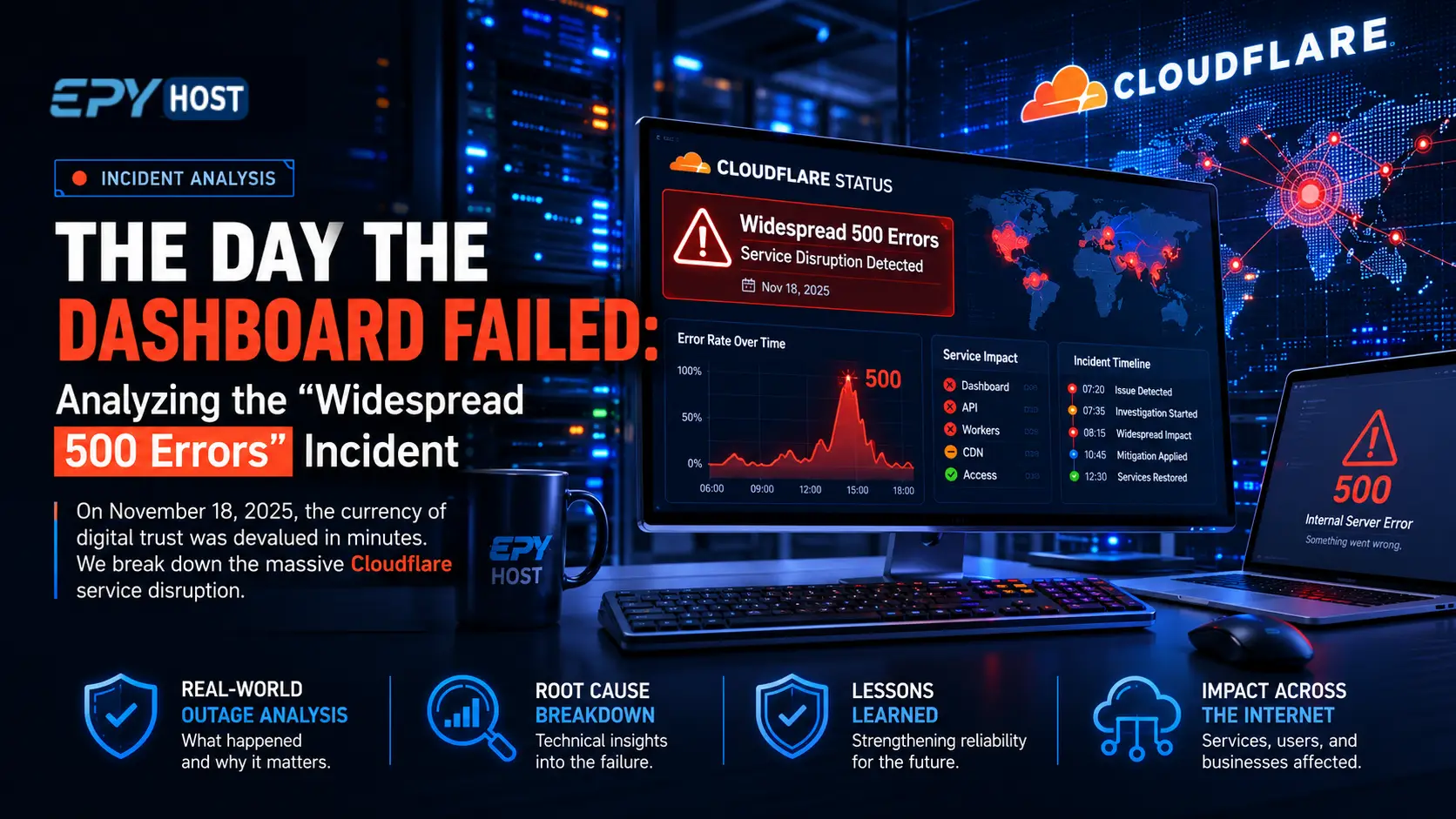
Date: November 18, 2025
Time: 11:48 UTC
Status: Critical Failure
It began as a ripple and ended as a tidal wave. At approximately 11:48 UTC, network engineers across the globe watched their monitors turn red. The world's largest content delivery network admitted to a critical failure: "Widespread 500 errors."
This wasn't just a localized glitch. The official incident report confirmed that the Cloudflare Dashboard and API were failing simultaneously, leaving IT teams unable to even log in to mitigate the issues. For millions of businesses, the internet simply stopped working.
The Cost of "Operational Standstill"
This incident serves as the starkest reminder yet that in the modern web, Network Uptime is the currency of digital trust. When that trust is broken via a 500 Internal Server Error, the consequences are immediate and severe.
As detailed in the immediate aftermath of the crash, downtime instantly translates to three catastrophic outcomes:
- 1. Massive Financial Loss: Every second of downtime is a transaction failed, an ad not served, and a subscription cancelled.
- 2. Erosion of Customer Trust and Reputation: Users don't care why you are down; they only care that you are down.
- 3. Operational Standstill: With APIs failing, internal tools, remote gateways, and automated deployments froze completely.
We must treat reliability not as a feature, but as the foundational requirement. The industry often talks about "resilience," but this event proved that many are merely paying lip service to the concept.
Timeline of the Failure
The incident logs paint a chaotic picture of the outage:
- 11:48 UTC: Cloudflare acknowledges they are "investigating an issue which impacts multiple customers." The symptoms are identified as widespread 500 errors.
- 12:03 UTC: Fifteen minutes into the blackout, the update is grim: "We are continuing to investigate this issue."
- The Blind Spot: Crucially, the update noted that the Dashboard and API were also failing. This meant that even if customers wanted to route traffic away from the failing network, they couldn't access the controls to do so.
The Pursuit of Perfect Resilience
The November 18 incident is a wake-up call to "double down on redundancy, proactive observability, and rapid incident response."
The uncomfortable truth revealed by this outage is that centralization is a risk. When we rely entirely on a single layer to protect our infrastructure, we inherit that layer's failures.
How to Bypass the Next Outage: The Dedicated Advantage
While the cloud panicked, another group of users remained online: those with Dedicated Infrastructure.
At EPY Host, we believe that while CDNs are useful, they should not be your only lifeline. When you deploy a Dedicated Server with us, you gain:
Total Access Control
Unlike cloud dashboards that go down, our IPMI and KVM access is completely independent of the public internet traffic layer. You always have the keys to your server.
Direct Routing Capability
You get a dedicated public IPv4. If a proxy service fails, you can reroute DNS directly to your EPY Host server origin, bypassing the outage instantly.
The November 18 incident proved that we need to improve more. It's time to secure your digital trust with hardware you actually control.
Explore All EPY Host Dedicated Servers
Don't let a centralized cloud failure take your business offline. Secure your digital assets with high-performance dedicated hardware that puts you in full control. From massive storage arrays to GPU-accelerated nodes, deploy the infrastructure you need to ensure 100% uptime.
 Recent Topics for you