The artificial intelligence revolution has officially transitioned from the research laboratory to the production floor. Over the past few years, the tech industry’s primary focus has been on building massive, multi-billion-dollar supercomputers to train foundational Large Language Models (LLMs), advanced computer vision systems, and complex predictive algorithms.
However, building an AI model is only half of the equation. Once the model is trained, it must be deployed into the real world to actually generate value. This deployment phase presents an entirely new set of infrastructural challenges. When autonomous vehicles, industrial robotics, and real-time fraud detection systems rely on AI, they cannot afford the latency of sending data back to a centralized cloud data center thousands of miles away.
They require Edge Computing.
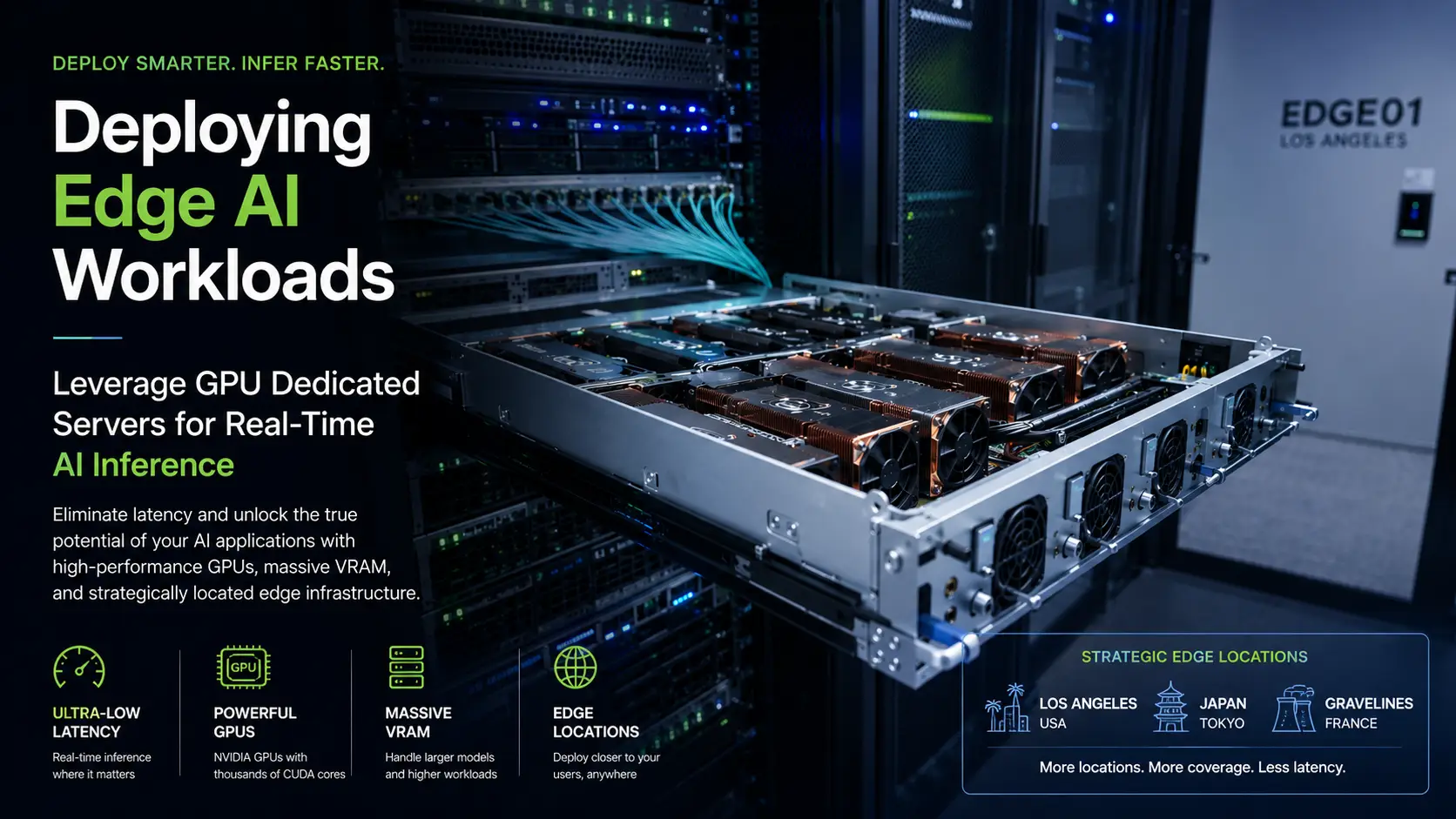
To deliver real-time, deterministic AI responses, system architects must push computational power out of the centralized cloud and directly to the geographic "edge" of the network, right next to the end-user. In this comprehensive guide, we will dissect the architecture of Edge AI. We will contrast the hardware requirements of AI training versus inference, explore the critical roles of CUDA cores and VRAM, and demonstrate how strategically deploying GPU-accelerated bare metal servers can eliminate latency and unlock the true potential of your AI workloads.
The Core Distinction: AI Training vs. AI Inference
To architect the correct infrastructure, you must fundamentally understand the difference between the two phases of an AI model's lifecycle: Training and Inference.
What is AI Training?
AI Training is the process of teaching a neural network to understand data. This involves feeding terabytes or petabytes of raw data (text, images, audio) into an untrained model. The system makes a prediction, compares it against the correct answer, and mathematically adjusts its internal weights and biases (a process called backpropagation) over millions of iterations (epochs).
Infrastructure Profile: Training is a massive, batch-processing workload. It requires centralized clusters of hundreds or thousands of interconnected GPUs (like the NVIDIA H100 or B200) communicating over ultra-high-speed networks (InfiniBand). It takes weeks or months to complete. Latency to the end-user does not matter during training; raw computational throughput is the only metric that counts.
What is AI Inference?
AI Inference is the application of the trained model in the real world. Once the model has learned the patterns, its weights are "frozen." When a user submits a prompt, or a camera feeds a video frame to the system, the model runs a single forward pass through its neural network to generate an output or prediction.
Infrastructure Profile: Inference is a real-time, transactional workload. It generally operates on a "batch size of 1" (a single user request). While it requires significantly less raw compute power than training, it is hypersensitive to latency. The user (or the autonomous machine) needs the answer immediately.
This fundamental difference is why infrastructure must be decentralized for deployment. Training happens in the core; Inference must happen at the edge. [Image illustrating the architectural differences between AI model training and AI inference pipelines]
The Imperative of Edge Computing in AI
Edge computing is the architectural practice of placing data processing facilities as close to the source of data generation as physically possible. In the context of AI, the "edge" is the difference between a seamless user experience and a critical system failure.
Consider a modern smart factory utilizing computer vision to detect microscopic manufacturing defects on a high-speed assembly line.
If the factory sends the 4K video stream to a centralized cloud data center in Virginia for inference, the round-trip network latency might be 150 milliseconds. By the time the AI detects the defect and sends the "halt production" command back, the defective part has already moved past the sorting mechanism.
If the factory utilizes an Edge AI server located in the same city (or the same building), the latency drops to 5 milliseconds. The AI processes the frame and halts the line instantly.
The physical distance data must travel over fiber optic cables dictates the absolute minimum time required to receive an AI prediction. For applications like real-time voice translation, algorithmic trading, augmented reality (AR), and autonomous navigation, network latency is the enemy. Edge AI solves this by bringing the GPU to the data. [Image comparing data flow and latency between edge computing architecture and centralized cloud computing]
Hardware Requirements for Inference: Beyond the CPU
When deploying an edge inference node, traditional enterprise servers powered solely by CPUs are vastly insufficient. Modern AI models, particularly LLMs and transformer-based architectures, rely on complex matrix multiplication. While a top-tier CPU might have 64 or 128 cores, an NVIDIA GPU has thousands of specialized cores designed to process these mathematical operations in parallel.
To provision the correct bare metal server for your Edge AI workloads, you must optimize for two specific hardware metrics: CUDA Cores and VRAM.
The Processing Engine: CUDA Cores
CUDA (Compute Unified Device Architecture) is NVIDIA’s parallel computing platform. CUDA cores are the individual, specialized processors within the GPU that execute the mathematical calculations required for a neural network's forward pass.
For inference workloads, the sheer number of CUDA cores—and the inclusion of specialized Tensor Cores designed specifically for AI data types like INT8 and FP16—determines how fast the model can generate a response (often measured in tokens-per-second for LLMs, or frames-per-second for computer vision).
The Bottleneck: VRAM (Video RAM)
While CUDA cores dictate the speed of the inference, VRAM dictates whether the model can run at all.
When you deploy an AI model, the entire model (all of its billions of parameters) must be loaded directly into the GPU's onboard memory. If the model is too large to fit in the VRAM, the system must swap data back and forth with the system's slower DDR5 RAM, resulting in catastrophic latency spikes. [Image explaining how VRAM acts as a bottleneck in GPU architecture during AI inference]
- A 7-billion parameter LLM (like Llama 3 8B) typically requires about 16GB to 24GB of VRAM to run comfortably with decent context windows.
- A larger 70-billion parameter model requires over 140GB of VRAM (usually necessitating multiple GPUs linked via NVLink).
When architecting your edge nodes, selecting the right GPU is entirely dependent on the size of your deployed models.
Explore our CUDA GPU Type Servers to find the perfect VRAM configuration for your models
Feeding the Edge: The Necessity of 10Gbps Networks
A common architectural blind spot in Edge AI deployment is network capacity. While placing a GPU close to the user solves the latency (ping) problem, it does not automatically solve the bandwidth (throughput) problem.
AI inference nodes are incredibly data-hungry. Consider a municipal smart city deployment where an edge server is running real-time traffic analysis and license plate recognition. The server is not just receiving a few lines of text; it is simultaneously ingesting dozens of high-definition RTSP video streams from street cameras.
If your edge server is bottlenecked by a standard 1Gbps uplink, the network port will saturate before the GPU even reaches 20% utilization. The video streams will drop frames, and the AI will miss critical events because the data simply couldn't reach the CUDA cores fast enough.
To ensure your edge GPUs are fully fed, deploying a 10gbps dedicated server USA or equivalent high-bandwidth infrastructure is mandatory. A 10Gbps unmetered port allows your inference engine to ingest massive amounts of raw telemetry, audio, and video data, process it in milliseconds, and broadcast the resulting metadata back to your central command center without ever choking on network congestion.
Geographic Deployment Strategy: Mapping the Global Edge
To build a globally responsive AI application, you cannot rely on a single data center. You must deploy a fleet of decentralized GPU bare metal servers in strategic geographic routing hubs to ensure that no matter where your user is located, they are within a 20-millisecond radius of an inference node.
1. The Pacific Hub: Capturing the West Coast
For companies developing AR/VR applications, autonomous delivery drones, or consumer-facing generative AI tools in North America, the West Coast is a primary target market.
Deploying a Dedicated server Los Angeles serves as the perfect edge node for this demographic. Los Angeles is a massive peering hub for Tier-1 internet service providers. By placing a GPU-accelerated bare metal server here, your AI application can process requests from San Diego up to Seattle with near-zero latency. Furthermore, LA serves as the primary gateway to the trans-Pacific subsea cables, allowing this node to act as a high-speed fallback for Asian traffic.
2. The Asian Edge: Powering High-Tech Populations
The Asia-Pacific region is adopting AI automation at a blistering pace, particularly in industrial robotics, retail analytics, and smart infrastructure. However, routing data from Asia to North America for processing introduces over 120 milliseconds of latency—making real-time AI impossible.
To serve this massive enterprise market, localizing your hardware is critical. A Bare metal server Japan in Tokyo provides an unparalleled edge environment. Tokyo is one of the most densely populated, tech-forward metropolitan areas on earth. By deploying localized inference servers here, you provide Japanese enterprise clients with instantaneous AI capabilities while ensuring full compliance with regional data sovereignty regulations (such as the APPI).
3. The European Edge: Eco-Friendly, Compliant Compute
Europe presents a unique challenge for AI deployment. The General Data Protection Regulation (GDPR) strictly dictates how user data can be handled, and the European energy crisis has made power-hungry GPU clusters incredibly expensive to operate in traditional hubs like London or Frankfurt.
To deploy edge inference in Europe securely and cost-effectively, forward-thinking architects look to specialized, green-energy data centers.
Deploy high-performance inference nodes with our Gravelines GPU location options
Gravelines, located in northern France, is strategically positioned to serve Western Europe with incredibly low latency. More importantly, data centers in this region heavily utilize localized, highly efficient cooling and nuclear-backed power grids. This allows you to run massive, 24/7 GPU inference workloads while maintaining a lower carbon footprint and ensuring that European facial recognition or voice data never leaves the EU jurisdiction.
Bare Metal vs. Cloud VMs for AI Inference
When deploying these edge nodes, you face the choice between public cloud Virtual Machines (VMs) and bare metal dedicated servers. For AI inference, bare metal is the definitive enterprise standard.
- 1. Eradicating PCIe Passthrough Overhead: In a cloud environment, you do not have direct access to the GPU. The cloud provider's hypervisor manages the hardware, and passes virtualized access (PCIe passthrough or vGPU slicing) to your instance. This virtualization layer introduces latency. When a prompt is submitted, it must traverse the hypervisor before hitting the GPU memory. On a bare metal server, your operating system and inference engine (like NVIDIA TensorRT or vLLM) have direct, unadulterated access to the physical PCIe lanes, maximizing throughput.
- 2. Sustained Thermal Performance: AI inference runs the GPU hot. If you are sustaining hundreds of concurrent API requests, the GPU will draw maximum wattage. Cloud providers densely pack hardware, which can lead to thermal throttling—where the GPU artificially slows its clock speed to prevent overheating, causing unpredictable latency spikes for your application. Dedicated bare metal servers provide isolated cooling and guaranteed thermal envelopes, ensuring your GPU can sustain 100% load indefinitely without throttling.
- 3. Predictable Cost at Scale: Public cloud providers charge exorbitant hourly premiums for GPU instances, coupled with metered egress bandwidth fees. If your AI application goes viral, or your computer vision cameras run 24/7, your monthly OpEx will explode. Leasing a bare metal GPU server provides a fixed, predictable monthly cost. You pay for the hardware and the network port, allowing you to maximize inference requests without worrying about usage penalties.
Security and Privacy at the Edge
Beyond latency and performance, Edge AI solves one of the most pressing concerns in the modern tech landscape: Data Privacy.
If you are deploying a healthcare AI that analyzes patient x-rays, or a retail AI that tracks customer demographics in a physical store, sending that raw, unencrypted data across the public internet to a central cloud is a massive security risk and a regulatory nightmare.
Edge inference changes the paradigm. By processing the data locally on a secure bare metal server in Los Angeles, Tokyo, or Gravelines, the raw data (the image or the voice recording) never leaves the local network. The GPU processes the data, extracts the necessary insight (e.g., "Defect detected," "Customer age demographic 25-34"), and only sends that anonymized, lightweight metadata back to your central servers. This architecture inherently minimizes your attack surface and drastically simplifies compliance with HIPAA, GDPR, and CCPA.
Conclusion: Architecting for the AI Era
The success of your AI application depends entirely on how quickly it can deliver an answer to the end-user. As models become more complex and integrated into our physical world, centralized cloud processing is no longer a viable architecture for deployment.
To win in the AI era, you must embrace the edge.
- Understand the Hardware: Recognize that inference demands raw single-pass speed. Prioritize high CUDA core counts and ensure you have sufficient VRAM to hold your models in memory.
- Clear the Network Bottlenecks: Don't let your GPUs starve for data. Deploy 10gbps dedicated server USA infrastructure to ingest massive streams of telemetry without packet loss.
- Decentralize Your Footprint: Push your compute power to the users. Capture the Americas with a Dedicated server Los Angeles, dominate APAC with a Bare metal server Japan, and secure Europe with an eco-friendly Gravelines deployment.
- Insist on Bare Metal: Eliminate hypervisor latency, avoid thermal throttling, and lock in your OpEx costs by utilizing dedicated hardware.
By strategically distributing GPU-accelerated bare metal servers to the edge of the network, you transform your AI from a slow, centralized research project into a hyper-responsive, global production powerhouse.
 Recent Topics for you