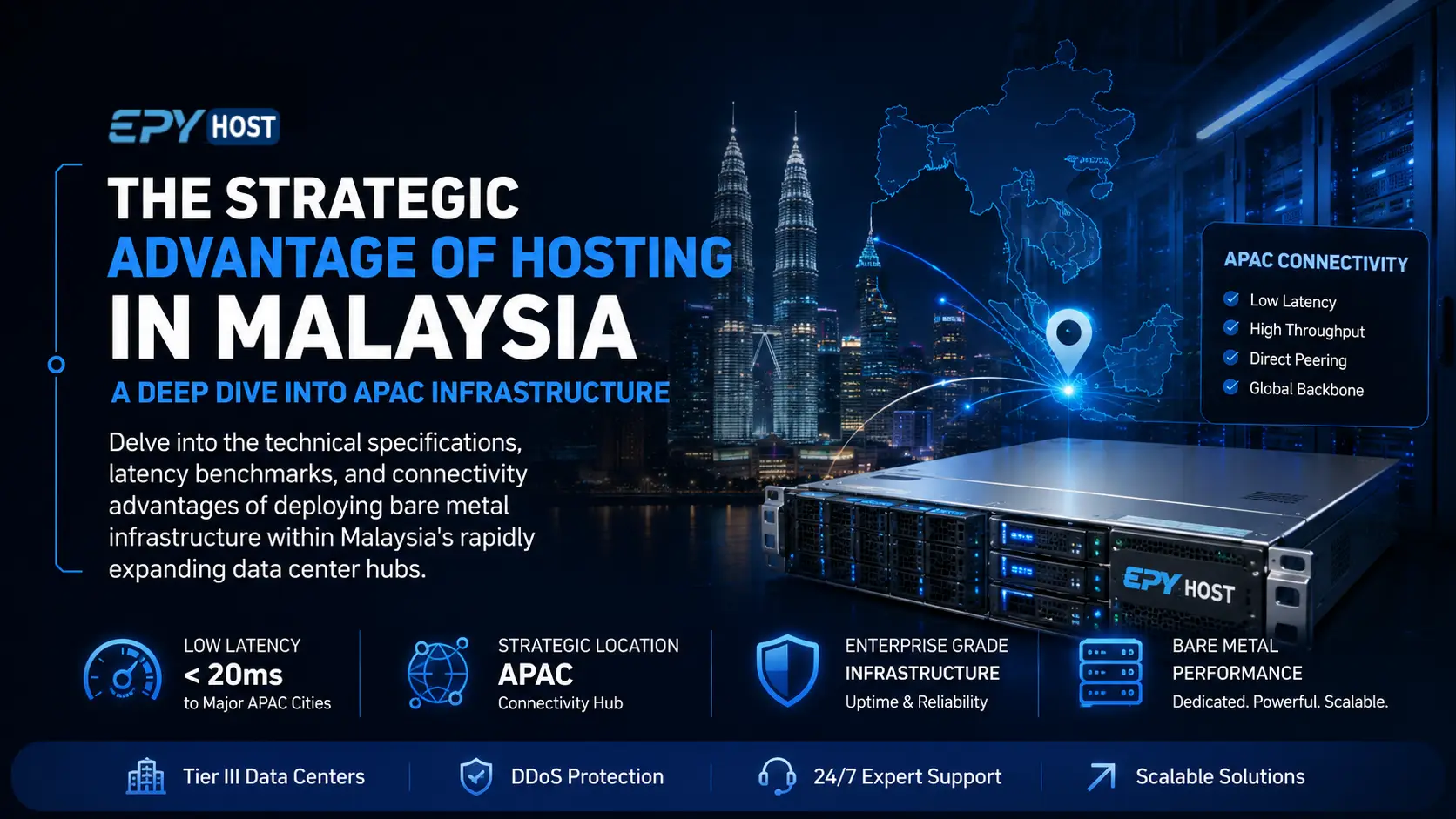
For years, Singapore has been the undisputed king of data center infrastructure in Southeast Asia. However, due to geographical constraints, land scarcity, and moratoriums on new data center builds initiated by the Singaporean government to manage carbon footprints, enterprise IT architects have had to cast their gaze slightly north. The result? Malaysia has emerged as a powerhouse for bare metal infrastructure in the APAC region.
Hosting your hardware in Malaysia is no longer just a cost-saving alternative; it is a strategic maneuver. With state-of-the-art facilities in Cyberjaya, Kuala Lumpur, and Johor, deploying infrastructure here offers a perfect balance of unmetered connectivity, sovereign data compliance, and enterprise-grade hardware capabilities that easily rival the world's top digital hubs.
Key Infrastructure Hubs: Cyberjaya, Kuala Lumpur, and Johor
When provisioning enterprise hardware in Malaysia, physical location plays a pivotal role in your network topology. The country operates three distinct technological zones, each serving specific routing and business functions:
- Kuala Lumpur (KL): As the financial and commercial heart of the country, KL data centers are heavily peered with local ISPs. This is the optimal deployment zone for localized retail, FinTech, and enterprise SaaS platforms requiring the lowest possible latency to the Malaysian populace.
- Cyberjaya: Often referred to as the "Silicon Valley of Malaysia," this planned city is part of the Multimedia Super Corridor (MSC). Data centers here are built from the ground up for high-density power and massive scalable cooling, making them ideal for heavy compute workloads, massive database clusters, and big data analytics.
- Johor: Situated directly across the border from Singapore, Johor is the strategic "spillover" hub. Submarine cables bridge the narrow geographical gap, allowing businesses to achieve near-identical Singaporean latency metrics (often 1-3ms) at a fraction of the hardware leasing costs.
Tier III & Tier IV Data Center Specifications
To support high-availability applications, top-tier Malaysian facilities are engineered strictly to Uptime Institute standards. When evaluating a data center here for your bare metal deployments, you can expect rigorous adherence to fault tolerance.
Power Redundancy (N+1 and 2N)
The primary grid is backed by independent substations. In the event of a grid failure, Uninterruptible Power Supply (UPS) systems instantly take over the load while diesel generators spin up. Facilities maintain SLAs of 99.99% to 99.999% uptime, supported by fuel contracts guaranteeing resupply within hours.
Advanced HVAC & Cooling Environments
Given the tropical climate, cooling is a critical engineering challenge. Premium facilities utilize chilled water systems with N+1 or 2N CRAH (Computer Room Air Handler) units, cold aisle containment, and strict humidity controls (typically maintaining temperatures between 20°C to 24°C and humidity at 40% to 60%) to prevent hardware degradation.
Network Topologies: Peering and Latency Benchmarks
A server is only as powerful as the network it connects to. Malaysia benefits from the Malaysia Internet Exchange (MyIX), a non-profit initiative that keeps local traffic local, significantly reducing transit times and bandwidth costs. Major upstream providers including Telekom Malaysia (TM), Time dotCom, and Maxis provide robust BGP (Border Gateway Protocol) routing.
By hosting in a central node like Kuala Lumpur, businesses can achieve excellent ping times to neighboring APAC nations. Below is an average latency benchmark table demonstrating the connectivity advantages of a Malaysian deployment.
| Destination Hub | Average Latency from Kuala Lumpur (ms) | Primary Use Case Impact |
|---|---|---|
| Singapore | 5 ms - 10 ms | Seamless database replication and High-Frequency Trading. |
| Jakarta, Indonesia | 25 ms - 35 ms | Excellent for live streaming and mobile gaming. |
| Bangkok, Thailand | 30 ms - 45 ms | Optimal for real-time E-commerce and API gateways. |
| Hong Kong | 40 ms - 55 ms | Fast bridge to East Asian financial markets. |
| Tokyo, Japan | 75 ms - 90 ms | Reliable asynchronous data backups and CDN edge nodes. |
Note: Latency metrics are approximate and can vary based on specific BGP routes, submarine cable health, and network congestion at the time of testing.
Data Sovereignty: Navigating the PDPA
For enterprise organizations, physical hosting location is heavily dictated by legal frameworks. Malaysia enforces the Personal Data Protection Act (PDPA), which regulates the processing of personal data in commercial transactions. By provisioning physical hardware within the country's borders rather than relying on decentralized public clouds, companies ensure absolute compliance with data localization mandates.
This is particularly critical for sectors such as banking, healthcare, and government contracting, where data cannot legally cross international borders without stringent safeguards. Operating dedicated physical hardware gives your organization total auditability, satisfying compliance officers and regulatory bodies alike.
Optimizing Hardware for APAC Traffic
Once the geographic and network advantages are established, selecting the correct physical components for your deployment is the final piece of the puzzle. Because you have exclusive access to the bare metal, you are not subjected to the "noisy neighbor" syndrome common in VPS or cloud environments.
- CPU Architecture: High-traffic web servers and single-threaded applications benefit immensely from Intel Xeon E-Series processors, while hypervisors and heavy virtualization nodes perform best on AMD EPYC’s high-core-count architecture.
- Storage Arrays: To maximize the 1Gbps or 10Gbps uplinks available in Malaysian data centers, deploying NVMe (Non-Volatile Memory Express) SSDs configured in hardware RAID 10 is highly recommended to eliminate I/O bottlenecks.
- DDoS Mitigation: As APAC experiences a high volume of cyber-attacks, ensuring your hardware is situated behind active L3-L7 traffic scrubbing is a necessity to maintain the SLA uptimes mentioned earlier.
Final Thoughts on Southeast Asian Deployments
Malaysia has undoubtedly matured into a primary destination for enterprise IT infrastructure. With world-class facilities in Cyberjaya, Kuala Lumpur, and Johor, unparalleled connectivity to the rest of APAC, and a highly favorable cost-to-performance ratio, it presents a compelling case for businesses scaling their digital footprint in the East.
Whether you are deploying gaming clusters, financial processing nodes, or high-volume E-commerce stores, ensuring your hardware is close to your users is paramount. To explore specific hardware configurations, unmetered bandwidth options, and immediate deployment availability, review our high-performance Kuala Lumpur dedicated servers and establish your foundation in Southeast Asia today.
 Recent Topics for you