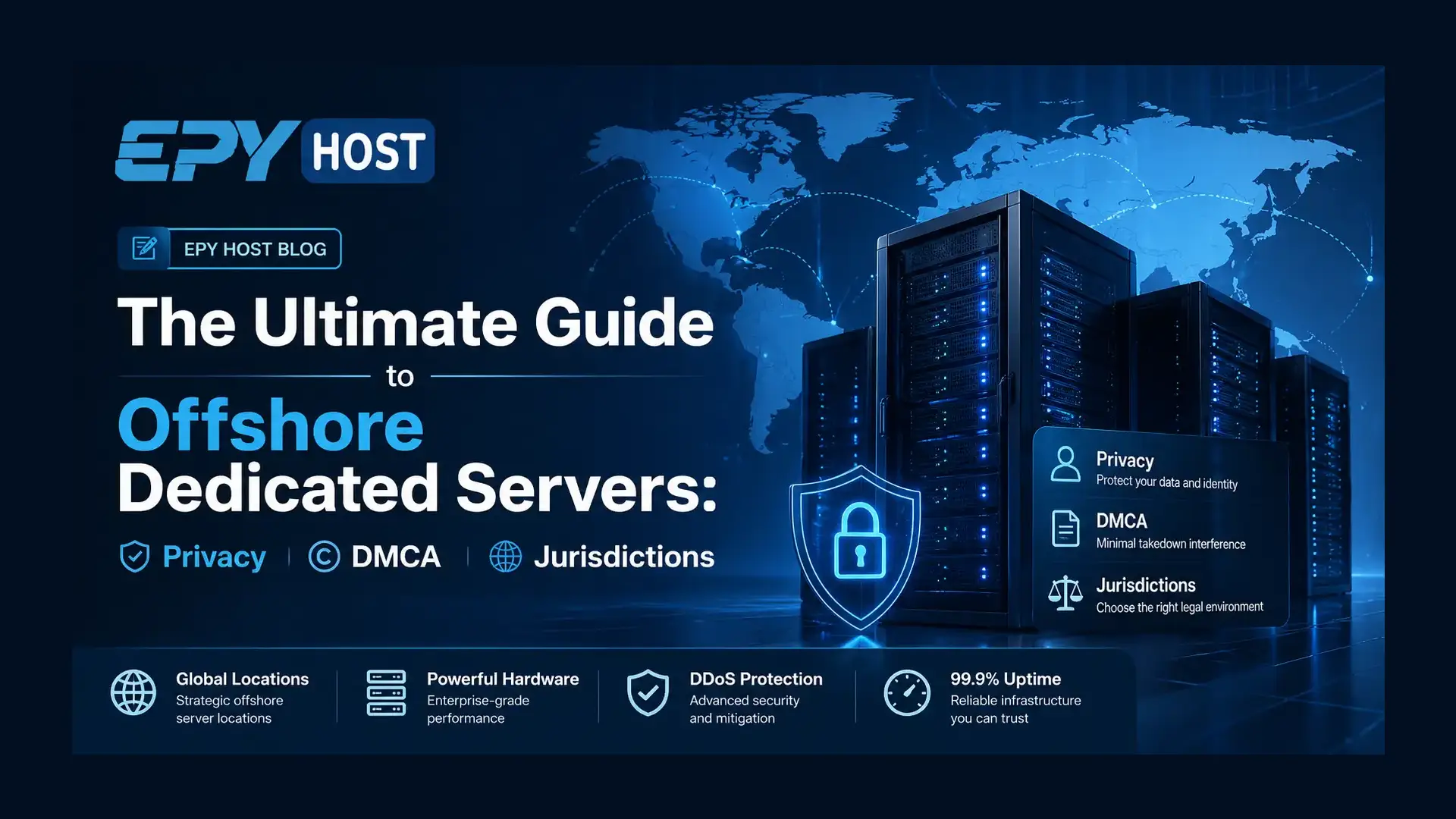
When architects and system administrators discuss server infrastructure, the conversation usually revolves around hardware: CPU cores, RAM allocations, NVMe speeds, and network throughput. However, for organizations dealing with sensitive data, journalism, or complex legal compliance, where your server is physically located is just as important as what is under the hood.
This is the domain of offshore hosting.
The term "offshore" occasionally carries an unwarranted stigma, conjuring images of shadowy operations. In reality, moving your infrastructure to an offshore dedicated server is a standard, highly strategic business decision. It is about data sovereignty, legal jurisdiction, privacy protections, and safeguarding your digital assets from overreaching local regulations.
In this comprehensive guide, we will break down the legal and technical advantages of offshore hosting, explore why specific jurisdictions are favored, and help you determine if an offshore architecture is the right fit for your workloads.
What is an Offshore Dedicated Server?
An offshore dedicated server is simply a bare metal server located in a country different from where you, your business, or your primary user base resides.
When you lease a dedicated server, you are renting physical hardware inside a data center. Crucially, the data resting on those physical hard drives is subject to the laws and regulations of the country where that data center is built.
By strategically choosing an offshore location, you are intentionally placing your data under the protection of a different legal framework. Organizations typically seek offshore hosting for three main reasons:
- Enhanced Data Privacy: Avoiding invasive surveillance programs (such as the US CLOUD Act or the Patriot Act).
- Favorable Content Laws: Hosting content that is legal in the server's jurisdiction but highly regulated in the user's home country (e.g., gambling, adult entertainment, or controversial journalism).
- Geographic Redundancy: Establishing a disaster recovery site far outside the domestic legal and environmental blast radius.
The Legal Landscape: Data Sovereignty and Jurisdiction
To understand offshore hosting, you must understand data sovereignty. This is the concept that digital data is subject to the laws of the country in which it is physically stored.
If you are a US-based company hosting data on a server in Texas, your infrastructure is bound by US law. Law enforcement can subpoena your data, and copyright holders can issue immediate takedown notices under the Digital Millennium Copyright Act (DMCA).
If you take that exact same data and move it to an Offshore dedicated server Netherlands, US laws no longer have direct, immediate jurisdiction over that physical machine. Instead, your server falls under Dutch law and the European Union's General Data Protection Regulation (GDPR).
This geopolitical firewall is the primary reason offshore hosting is so highly valued. It forces third parties who want to access your data or take down your website to navigate complex international treaties and foreign legal systems, providing you with a critical layer of operational security and legal breathing room.
Why Choose Amsterdam for Data Privacy?
When it comes to offshore hosting, Europe—and specifically the Netherlands—is often considered the gold standard. But why?
1. Robust Privacy Laws
The Netherlands boasts some of the strictest consumer privacy and data protection laws in the world. As a member of the EU, it enforces the GDPR, which heavily restricts how data can be collected, processed, and handed over to third parties. Furthermore, the Dutch legal system places a high value on freedom of speech and digital privacy, making it an incredibly safe harbor for journalists, whistleblowers, and privacy-centric applications like VPN providers.
2. The Reality of the "DMCA Ignored Server Amsterdam"
If you have researched offshore hosting, you have likely encountered the phrase DMCA ignored server Amsterdam. It is important to be candid and correct a common misconception here: the Netherlands is not a lawless digital frontier.
The DMCA (Digital Millennium Copyright Act) is strictly a United States law. It carries zero legal weight in the Netherlands. Therefore, a Dutch data center is not legally obligated to instantly shut down your server just because a US entity sends a DMCA complaint. In that sense, the DMCA is "ignored."
However, the Netherlands has its own copyright framework, known as the Notice-and-Take-Down (NTD) code. The difference is that the Dutch NTD process is generally much more rigorous. It requires the complainant to provide substantial proof of copyright infringement before action is taken, preventing the automated, often abusive, and frivolous takedown requests commonly seen in the US. This gives server administrators time to review complaints and respond without their network being abruptly pulled offline.
3. World-Class Infrastructure
Beyond the legal benefits, a Netherlands dedicated server is a technical powerhouse. Amsterdam is home to AMS-IX (Amsterdam Internet Exchange), one of the largest internet exchanges on the planet. Hosting your infrastructure here provides unparalleled low-latency connectivity across Europe, into the Middle East, and across the Atlantic to North America.
The Role of Canadian Data Centers in Offshore Hosting
While Europe is excellent for absolute privacy, it does introduce a physical distance that increases latency for North American users. If your primary audience is in the US, but you still require legal separation from the US government, an Offshore dedicated server Canada is the optimal compromise.
1. Latency and Performance
Data centers located in Toronto or Montreal are physically closer to major US hubs like New York and Chicago than many internal US data centers are to each other. By choosing an offshore server in Canada, you can deliver sub-20ms ping times to the East Coast of the United States while keeping your hardware outside of US jurisdiction.
2. PIPEDA vs. The Patriot Act
Canada's privacy laws are governed by PIPEDA (Personal Information Protection and Electronic Documents Act). While Canada is part of the "Five Eyes" intelligence alliance, PIPEDA offers far more robust commercial data protections than US law. Unlike the US CLOUD Act, which allows US authorities to demand data from US tech companies regardless of where the server is located, Canadian companies operating strictly within Canada require formal, court-ordered warrants under Canadian law to hand over data.
An Offshore dedicated server Canada provides an excellent balance: high-speed, low-latency access for US consumers, wrapped in a legal framework that respects corporate data sovereignty and consumer privacy.
Evaluating Emerging Offshore Locations: The Middle East
While traditional hubs like the Netherlands and Canada dominate the market, emerging tech hubs in the Middle East are becoming highly strategic locations for offshore dedicated servers.
For companies looking to serve the MENA (Middle East and North Africa) region or bridge the gap between Europe and Asia, establishing infrastructure in the Gulf is crucial. By deploying dedicated servers in Qatar, businesses can achieve hyper-local compliance in a region with its own distinct data protection laws. This is particularly vital for financial tech (FinTech) and e-commerce platforms that must comply with local data residency requirements, ensuring that user data generated in the Gulf stays within the Gulf, while still benefiting from top-tier fiber optic connectivity.
Technical Benefits of Offshore Bare Metal
Moving offshore isn't just about legal maneuvering; it's also about securing your infrastructure at the hardware and network level. When dealing with sensitive operations, shared hosting or cloud VPS environments are inherently risky due to the "noisy neighbor" effect and shared hypervisor vulnerabilities.
1. Complete Hardware Isolation
With an offshore dedicated server, you lease the entire physical machine. There is no virtualization layer shared with other unknown entities. You have root access to the bare metal, allowing you to encrypt the drives at the hardware level and compile custom, security-hardened kernels.
2. Private Networking
For ultimate security, offshore infrastructure should utilize Private Networking features. This allows you to link multiple dedicated servers (e.g., a web node in Amsterdam and a database node in Canada) via secure, unmetered backend channels that never touch the public internet. By keeping your database isolated on a private VLAN, you drastically reduce your attack surface.
3. Advanced Threat Mitigation
Because offshore servers often host controversial or highly targeted content, offshore data centers are usually equipped with massive, multi-terabit DDoS mitigation hardware. They are designed to absorb and scrub volumetric attacks that would otherwise blackhole standard domestic servers.
Jurisdiction Comparison Guide
To help you make an informed decision, here is a quick comparison of the three primary hosting jurisdictions:
| Feature/Jurisdiction | United States | Netherlands (Offshore) | Canada (Offshore) |
|---|---|---|---|
| Primary Privacy Law | Sector-specific (HIPAA, etc.) | GDPR | PIPEDA |
| DMCA Compliance | Strict & Immediate | "Ignored" (Uses Dutch NTD) | Notice-and-Notice System |
| Data Sovereignty | Subject to CLOUD Act | High protection | Moderate/High protection |
| Best Used For | Domestic US Audiences | High Privacy, VPNs, Adult | US Audiences requiring privacy |
| Latency to US East | < 15ms | ~80ms - 100ms | < 20ms |
How to Choose the Right Offshore Provider
Not all offshore providers are created equal. When selecting an infrastructure partner for your international servers, look for the following criteria:
- Owned Hardware: Ensure the provider actually owns the servers and network equipment rather than just reselling a third-party cloud.
- Cryptocurrency Payments: For ultimate privacy, look for providers that accept Bitcoin or other decentralized currencies, keeping your financial identity separate from your server infrastructure.
- Transparent Routing: Check their BGP mix and peering agreements. A good offshore server should have premium transit providers to minimize the latency impact of crossing oceans.
- No Questions Asked (Within Reason): A reliable offshore provider will respect your privacy and will not arbitrarily inspect your data, provided you are not violating the baseline terms of service or international laws against heinous crimes.
Conclusion
Building your infrastructure on an offshore dedicated server is a powerful strategy for ensuring data sovereignty, protecting user privacy, and insulating your business from aggressive domestic takedown policies.
Whether you require the ironclad privacy laws and robust copyright handling of a Netherlands dedicated server, or the low-latency, North American proximity of an Offshore dedicated server Canada, understanding the legal jurisdiction of your hardware is step one in architecting a resilient digital presence.
By combining the legal advantages of these offshore locations with bare-metal hardware isolation and private networking, you can build a highly secure, unshakeable foundation for your most critical workloads.
 Recent Topics for you