As we navigate the escalating threat landscape of 2027, standard software-based security operates on a dangerous assumption: that the underlying physical hardware is inherently trustworthy. When deploying critical enterprise applications on dedicated servers, relying solely on operating system security and perimeter firewalls leaves the foundational layer exposed.
Advanced persistent threats, bootkits, and supply-chain compromises target the firmware and management interfaces long before the operating system even loads. True cyber security requires locking down the raw hardware. By systematically isolating out-of-band management, enforcing cryptographic trust through TPM 2.0, and hardening the BIOS/UEFI, organizations can establish a zero-trust architecture that begins at the silicon level.
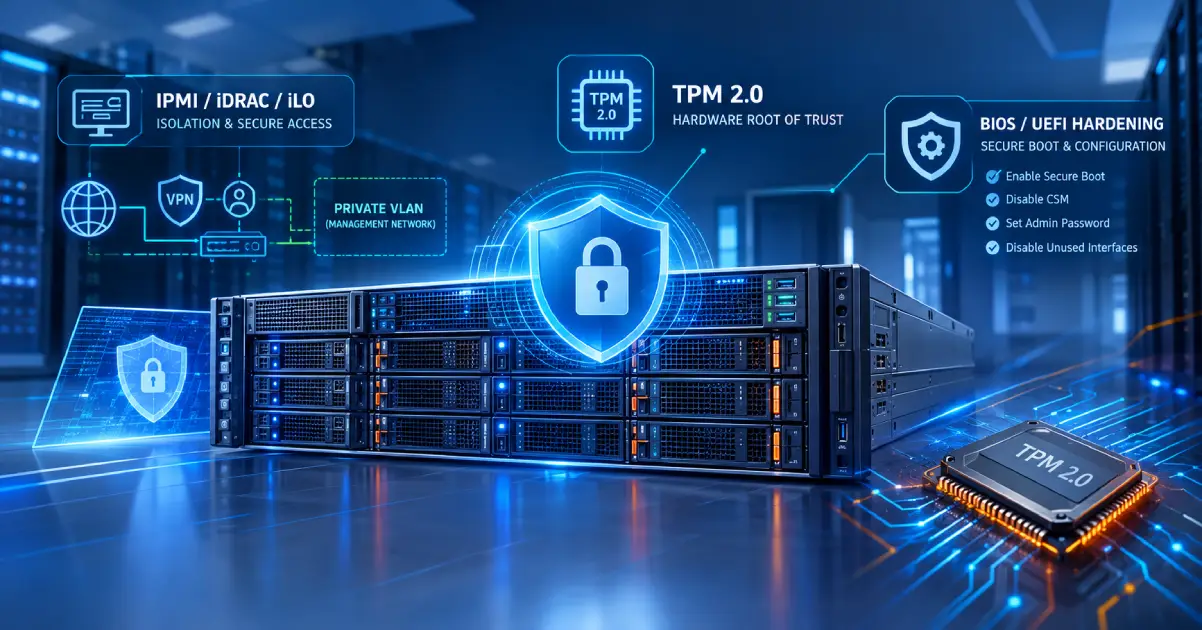
Isolating Out-of-Band Management (IPMI, iDRAC, iLO)
Baseboard Management Controllers (BMCs) provide critical out-of-band management capabilities, allowing administrators to reboot servers, mount virtual media, and access the console directly at the hardware level. Technologies like IPMI, Dell iDRAC, and HP iLO are indispensable for remote server security and maintenance, but they are also prime targets for exploitation. If a BMC is exposed directly to the public internet, attackers can bypass all operating system controls, reinstall the OS, or extract data directly from memory.
To eliminate this attack vector, out-of-band management interfaces must be strictly isolated from production traffic using modern 2027 protocols:
🛡️ Deploy on Dedicated Private VLANs
Route all IPMI traffic through a separate, non-routable private network that is physically or logically segregated from public-facing server traffic.
🔐 Enforce VPN-Only Access
Require administrators to connect via an encrypted IPsec or WireGuard VPN before they can reach the IPMI web interface or SSH ports.
⚠️ Disable Default Credentials
BMCs often ship with standardized factory credentials. Changing these to complex, dynamically generated passwords during the initial provisioning phase is mandatory.
🎯 Implement IP Whitelisting
If a dedicated VPN is not feasible, restrict IPMI access at the datacenter edge switch to a strict whitelist of known corporate static IP addresses.
Establishing Hardware Root of Trust with TPM 2.0
A Trusted Platform Module (TPM 2.0) is a dedicated microcontroller designed to secure hardware through integrated cryptographic keys. Rather than storing encryption keys within the operating system where they can be scraped by malware, TPM 2.0 stores them on a physical chip soldered to the motherboard. This establishes a hardware root of trust, ensuring that the server environment has not been tampered with while powered down or in transit.
In a modern bare metal environment, TPM 2.0 is critical for robust hardware security. It seamlessly integrates with technologies like Linux Unified Key Setup (LUKS) to enable secure full-disk encryption. When the server powers on, the TPM verifies the integrity of the bootloader and firmware signatures. If it detects unauthorized modifications—such as a malicious firmware flash or a compromised kernel—the TPM refuses to release the decryption keys, halting the boot process and protecting the data on the NVMe drives from extraction.
Enforcing BIOS/UEFI Hardening and Secure Boot
The transition from legacy BIOS to the Unified Extensible Firmware Interface (UEFI) introduced vital security mechanisms that are frequently left unconfigured. BIOS hardening prevents unauthorized users from altering the boot sequence, overriding security protocols, or booting the server from a malicious USB drive or unauthorized network image.
✅ Enable UEFI Secure Boot
This protocol checks the cryptographic signature of each piece of boot software. Unsigned or maliciously modified code is instantly blocked from executing.
🚫 Disable the CSM
The Compatibility Support Module (CSM) allows servers to boot legacy OS environments. Disabling CSM forces the system to rely entirely on the more secure native UEFI mode.
🔑 Set an Admin UEFI Password
Prevent unauthorized changes to hardware configurations or boot orders by locking the UEFI configuration utility with a strong administrative password.
🔌 Disable Unused Interfaces
Turn off physical USB ports, serial ports, and Preboot Execution Environment (PXE) network booting capabilities if they are not actively required for operations.
The EPY Host Bare Metal Advantage
Securing the firmware layer requires a hosting provider that grants you absolute control over your infrastructure without restricting access to critical hardware settings. EPY Host provisions bare metal dedicated servers with full administrative access to both the operating system and the underlying hardware.
Our 2027 infrastructure supports modern UEFI configurations, physical TPM 2.0 modules, and dedicated IPMI ports that can be isolated within custom private VLANs. This level of autonomy ensures that you can implement comprehensive, military-grade hardware security policies tailored exactly to your compliance requirements.
 Recent Topics for you