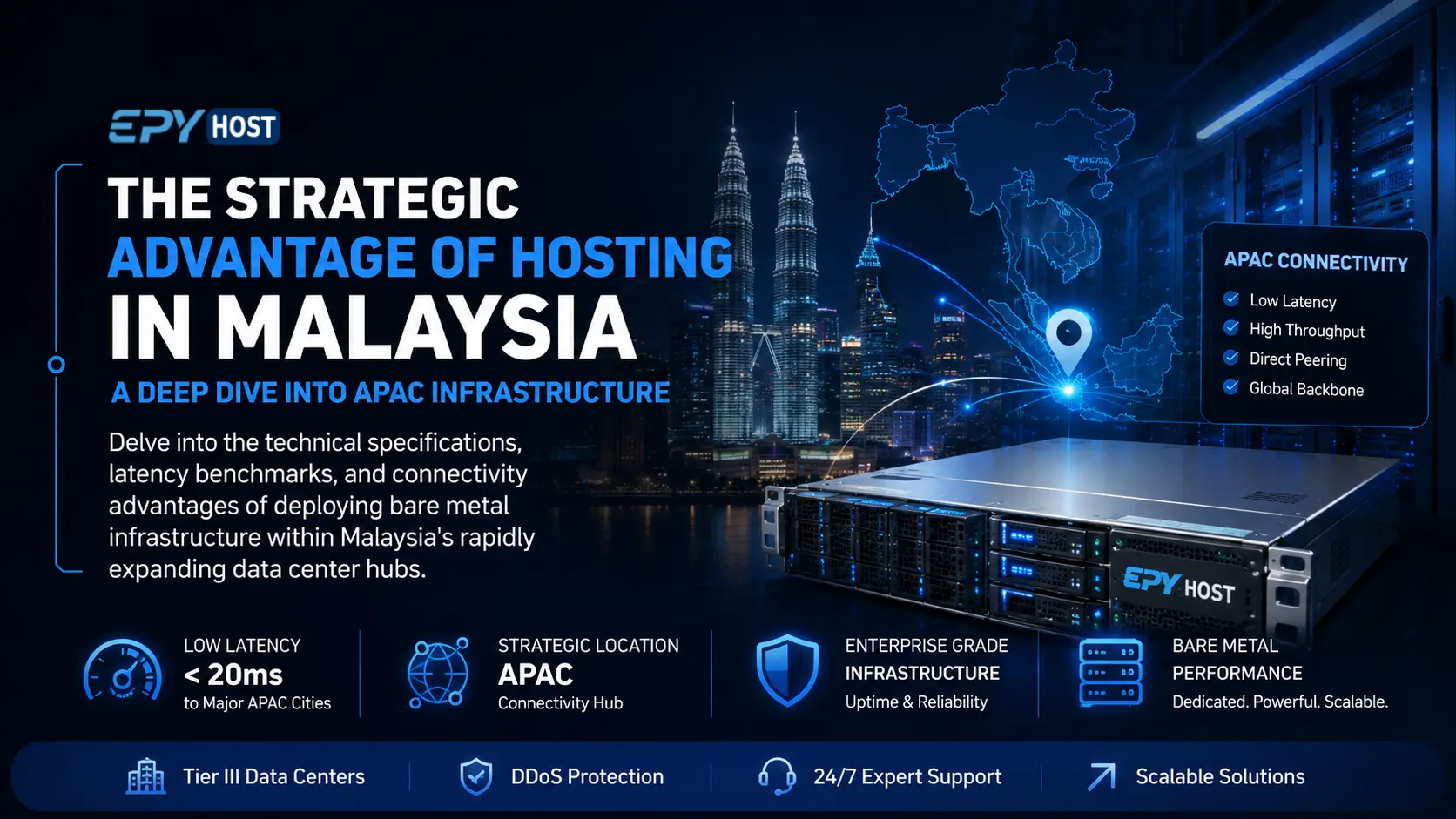
As digital transformation accelerates across Southeast Asia, enterprises are shifting their focus from generic cloud compute to highly specialized bare metal infrastructure. In 2026, two massive technological drivers are reshaping how data is processed in the APAC region: the explosion of Edge AI Inference and the tightening of data sovereignty regulations regarding big data storage.
Running real-time video analytics for smart cities in Jakarta, or training localized financial models for banks in Kuala Lumpur, requires processing power placed as close to the data source as possible. You cannot afford the latency of sending terabytes of raw data to a centralized cloud in North America. Furthermore, under data protection laws like Singapore's PDPA, routing sensitive user data across the globe introduces massive compliance risks.
The architectural solution is deploying dedicated, hardware-accelerated nodes in Southeast Asia's primary connectivity hub: Singapore. In this technical breakdown, we will explore how to pair dual-socket Intel Xeon environments with Nvidia A16 GPUs for AI edge processing, and how to structure localized NVMe/SSD storage arrays to build a high-throughput, legally compliant regional data lake.
Edge AI Inference: Moving Beyond the CPU
Traditional CPU-bound servers are insufficient for modern AI workloads. While massive AI training clusters grab the headlines, the day-to-day reality of SaaS and enterprise AI in Southeast Asia is inference—the act of applying a trained model to new, real-world data in real-time.
Inference requires high concurrency and exceptional memory bandwidth. For these specific edge workloads, including high-density Virtual Desktop Infrastructure (VDI), video transcoding, and AI-driven computer vision, the Nvidia A16 GPU is the premier architectural choice.
Hardware Profile: Dual Intel Xeon Silver 4214 + Nvidia A16
To prevent the CPU from bottlenecking the GPU, infrastructure architects utilize balanced bare metal configurations. A standard enterprise deployment for AI edge nodes relies on Dual Intel Xeon Silver 4214 processors. With 24 physical cores (48 threads) across the dual sockets operating at a 2.20 GHz base clock, the system provides enough raw compute to handle complex network routing, data ingestion, and OS overhead without stalling.
The heavy lifting is offloaded to the Nvidia A16. Unlike GPUs designed purely for maximum single-model performance, the A16 is built for extreme density and concurrent streams. Its unique architecture provides:
- Segmented VRAM (4x 16GB): The A16 features a unique quad-GPU board design, offering a total of 64GB GDDR6 memory segmented into four 16GB allocations. This allows you to run multiple independent inference models simultaneously without resource collision.
- High-Speed Bus Width: Utilizing a 4x 128-bit bus width, the card ensures rapid communication between the GPU cores and the localized VRAM.
- Massive Memory Bandwidth: With a bandwidth of 4x 200GB/s, the A16 can ingest real-time telemetry, live video feeds, or financial tick data instantly, ensuring that AI decisions are generated in milliseconds.
By placing this specific hardware profile in Singapore, SaaS providers can deliver real-time AI features to end-users in Vietnam, Indonesia, and Malaysia with sub-30ms network latency.
Architecting Regional Storage: NVMe and SSD Tiering
Generating AI insights is only half the equation; the other half is securely storing the massive datasets required to feed those models. Cloud block storage scales easily, but its network-attached nature introduces severe I/O bottlenecks when dealing with unstructured big data.
To maximize database performance and comply with data residency laws, enterprises must construct localized, bare metal storage arrays utilizing strict data tiering principles.
Hot Data: NVMe Bare Metal Arrays
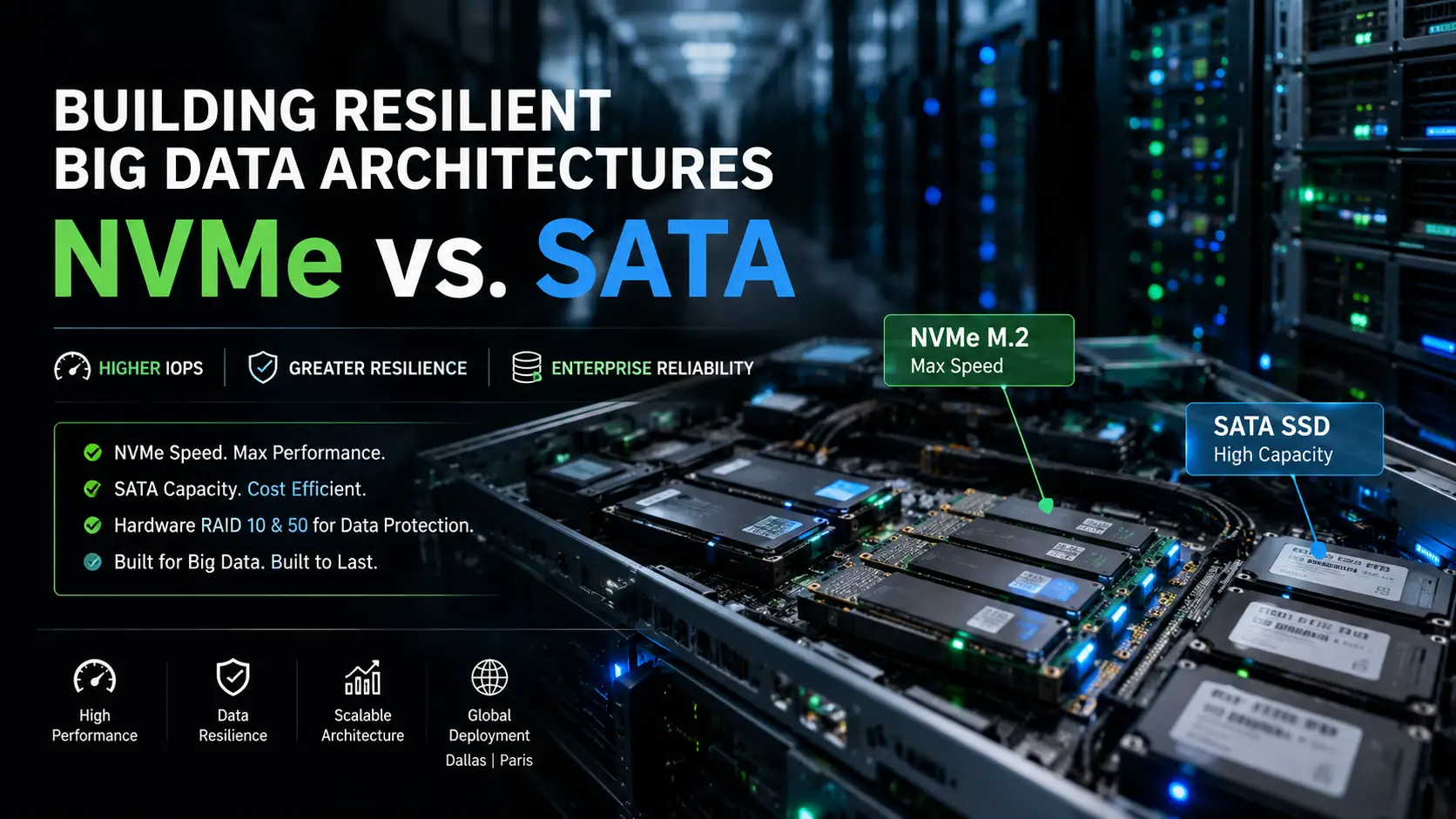
For "hot" data—information that requires instantaneous read/write access, such as active transaction databases, real-time analytics indices, and in-memory caches—NVMe (Non-Volatile Memory Express) is mandatory. Because NVMe drives connect directly to the server's PCIe lanes, they bypass the legacy SATA/SAS controller bottlenecks. A bare metal storage server equipped with enterprise NVMe drives can deliver millions of IOPS (Input/Output Operations Per Second), drastically accelerating complex database queries across the APAC region.
Warm Data: High-Density Enterprise SSDs
For "warm" data—such as user media, application backups, and historical logs used for asynchronous machine learning training—Enterprise SSDs provide the perfect balance of speed and capacity. While not as fast as NVMe, localized SSD storage servers in Singapore ensure that massive datasets can be retrieved and processed by your CPU/GPU nodes without incurring the exorbitant egress fees associated with public cloud storage providers.
Consolidating Your APAC Infrastructure
Scaling complex SaaS and AI applications requires precise hardware control. By combining dual Intel Xeon compute, high-density Nvidia A16 GPUs, and tiered NVMe/SSD storage into a unified local network, you eliminate the latency and bandwidth limits of public cloud environments.
To explore the hardware specifications, Tier-1 network connectivity, and pricing options necessary to execute this architecture, view our enterprise dedicated server infrastructure in Singapore. Deploying bare metal hardware at the edge is the most effective way to guarantee performance, ensure PDPA compliance, and secure your competitive advantage in the Southeast Asian market.
 Recent Topics for you